To begin with, there is a growing pressure on all kinds of industries in India to reduce their use of fresh water. Basically, to comply with the rules concerning water discharge, and to reuse treated wastewater; as a result, the textile, pharmaceutical, chemical, food processing, dairy, hospitality and automobile industries are now adopting advanced biological treatment technologies such as Membrane Bioreactors, more commonly referred to as MBR systems.
Now, by combining biological wastewater treatment with membrane filtration, an MBR system eliminates the need for a conventional secondary clarifier and results in an effluent that is both high in quality and of low turbidity, making it appropriate for reuse or for further treatment by means of reverse osmosis. The performance of an MBR plant, however, is very much dependent on the quality, design, and support offered by the membrane manufacturer.
Firstly, it is not enough merely to compare the prices of different MBR membrane manufacturers in India; buyers have to consider the membrane material, the filtration performance, the chemical resistance, compatibility with the system, the cleaning requirements, the quality of technical support, the availability of replacements, and the total cost of ownership.
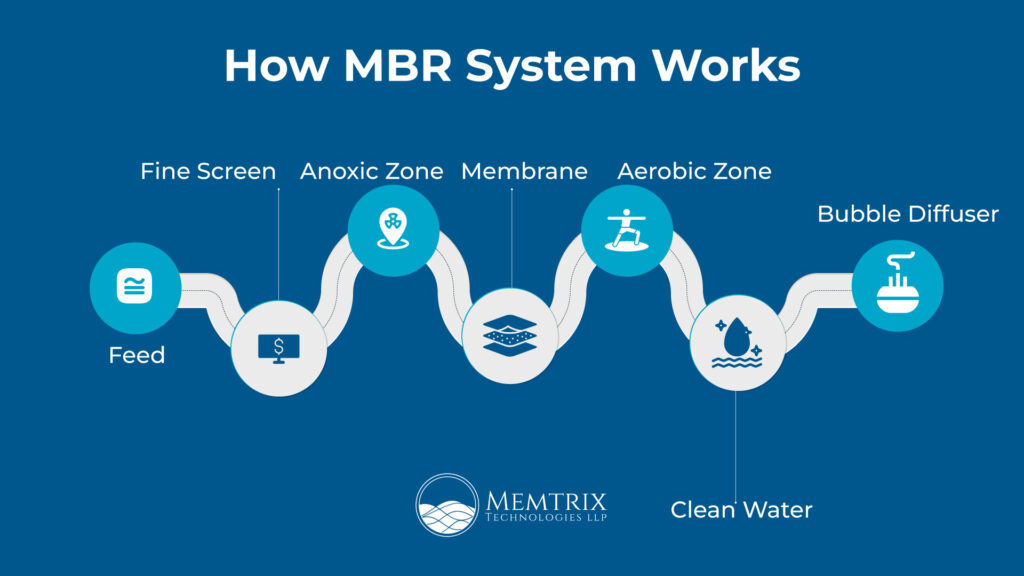
What is an MBR membrane?
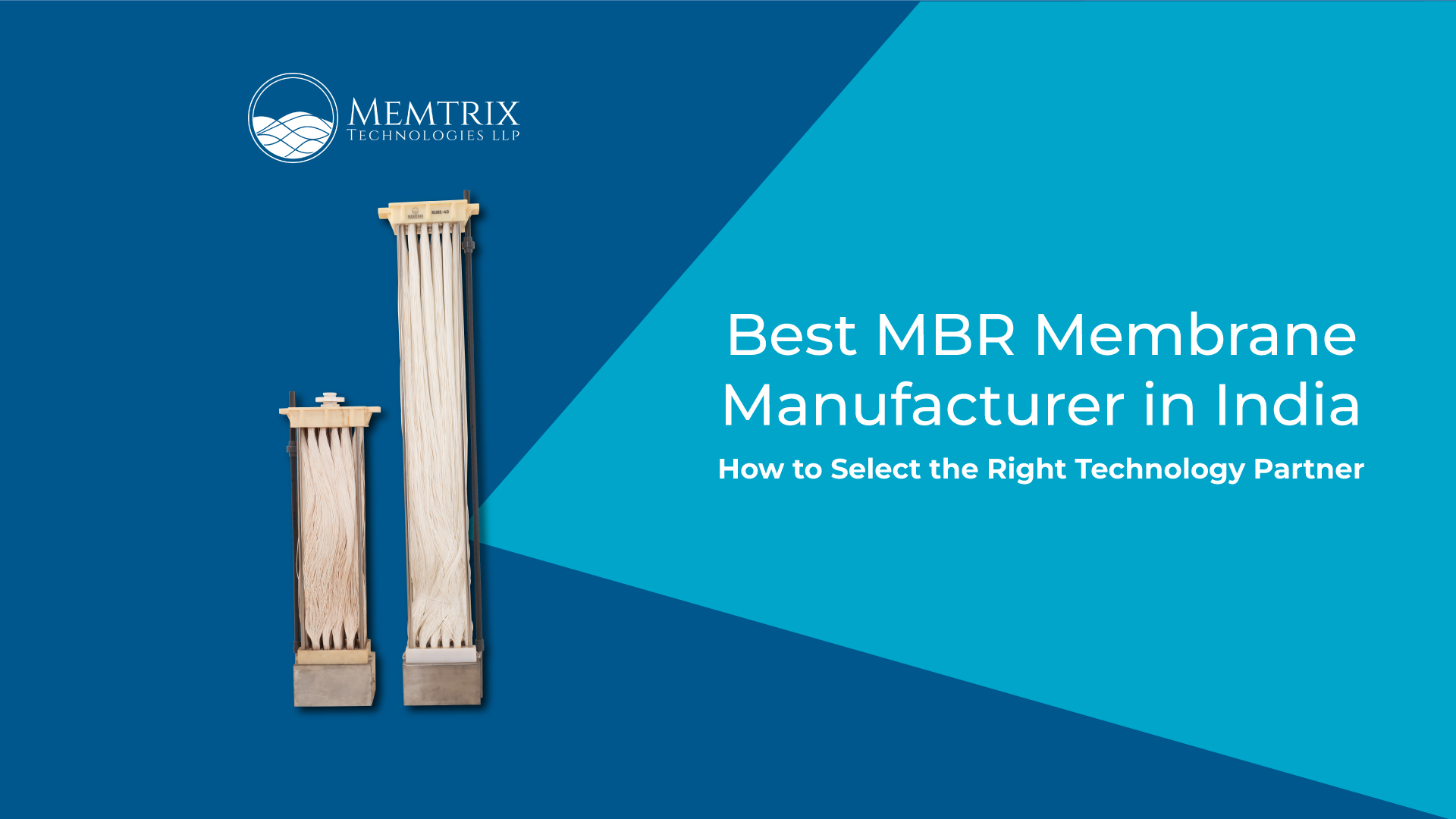
An MBR membrane is one which serves as a microfiltration or ultrafiltration membrane for separating treated wastewater from activated sludge and it can be installed either as a submerged system inside the bioreactor or externally in a side-stream arrangement.
Moreover, most industrial MBR membranes are manufactured using materials such as:
- PVDF is known for its mechanical strength and chemical resistance.
- PTFE is suitable for use in demanding applications where high chemical and thermal resistance is required.
- Polymers such as PES and others, which are used in certain filtration applications.
- Hollow-fibre structures that have been reinforced, leading to greater durability and resistance to breaking.
While the water is being treated, it goes through the pores of the membrane, and the suspended solids, bacteria, and the majority of the microorganisms stay behind in the biological reactor. Finally, the outcome is a clear permeate containing very little suspended solids and turbidity.
What is the advantage of selecting a manufacturer in India?
Firstly, the membrane industry in India has developed a great deal, and Indian manufacturers are now more and more offering hollow-fibre, flat-sheet, and retrofit MBR membrane solutions. Secondly, several of the country’s manufacturers are able to provide membrane production in-house, along with module assembly, system integration, and after-sales service.
In fact, one of the main benefits of choosing a Indian manufacturer of MBR membranes like Memtrix Technologies is the availability that it provides. Membranes that are imported can lead to longer waiting times, entail customs formalities, expose the company to foreign exchange risks, and make it difficult to get urgent replacement modules. By contrast, a local manufacturer can provide quicker delivery, facilitate easier communication, and offer technical support which is appropriate for the wastewater conditions in India.
Recent developments in the industry also show that membrane manufacturing is becoming more localised in India.
Indian should not simply be taken to mean “low cost” or “high quality”; the manufacturer has to be evaluated on the basis of technical and commercial criteria.
Qualities of the Best MBR Manufacturer
Proven application experience
The manufacturer ought to have experience in dealing with wastewater similar to yours since domestic sewage, textile effluent, pharmaceutical wastewater, dairy wastewater, and chemical effluent all have very different characteristics.
Then, ask for relevant references involving:
- Similar wastewater composition.
- Comparable flow capacity.
- The organic and solids loading is similar.
- Required treated-water quality.
- Similar operating conditions.
Also, a supplier who has extensive experience in the area of industrial wastewater will be able to suggest suitable pretreatment, biological conditions, membrane flux, aeration, and cleaning procedures.
Reliable membrane material
The material of the membrane has a direct impact on both the service life and operating stability. Similarly, PVDF is widely used since it provides a reasonable balance of strength, chemical resistance, and filtration performance. Although PTFE might be appropriate for more severe applications, its cost and the requirements of the system should be carefully evaluated.
The manufacturer should clearly disclose:
- Membrane material.
- Nominal pore size or molecular weight cut-off.
- Fiber size or flat-sheet shape.
- Operating flux range.
- Transmembrane pressure range.
- Chemical cleaning compatibility.
- Recommended air-scouring rate.
Consistent Manufacturing Quality
Most importantly, the quality of the membrane is influenced not just by the polymer but also by the consistency of the manufacturing process; variations in wall thickness, pore structure, bonding, potting, or module assembly can all result in uneven performance and early failure.
Likewise, a professional manufacturer should maintain quality controls for:
- Raw-material inspection.
- Membrane fohttps://memtrix.in/how-smart-cities-use-waste-water-reuse-technology/rmation.
- Fibre integrity.
- Module potting.
- Pressure testing.
- Permeability testing.
- Leak detection.
- Batch traceability.
The supplier ought to be willing to supply test data and technical documents rather than depending merely on marketing claims.
Complete System knowledge
The MBR membrane cannot be assessed on its own from the entire treatment system since membrane performance is influenced by the biological loading, the mixed-liquor suspended solids, the dissolved oxygen, the sludge age, the aeration, the pretreatment, and the cleaning frequency.
The best MBR membrane manufacturer or supplier should understand:
- Fine screening requirements.
- Equalisation requirements.
- Control of oil and grease.
- Biological nutrient removal.
- Sludge management.
- Membrane aeration.
— CIP or cleaning for recovery.
- Permeate pumping.
- Instrumentation and automation.
Certain suppliers offer only replacement membranes, whereas others provide complete packages of Industrial Water Treatment Solution. When it comes to a new plant, a supplier who is able to engineer and commission the entire MBR system can help reduce the integration risks.
MBR Membrane Applications
MBR technology is usually chosen when both high-quality treated water and a small plant footprint are important; typical uses include:
—The treatment of wastewater from the textile and dyeing industries.
- Wastewater from the pharmaceutical and healthcare sectors.
— The processing of food and drinks.
- Dairy and slaughterhouse wastewater.
- Hotels and homes.
- Sewage treatment for industrial estates.
- The reuse and recycling of wastewater.
– The treatment process for RO and ZLD systems.
However, in order to reuse the water in industrial regions that suffer from water stress, the permeate from MBR systems can be treated using RO . For instance, a project in Ahmedabad involving the reuse of textile wastewater combined MBR and RO technologies and stated that it achieved high water recovery as part of a ZLD-oriented treatment system.
Questions to Ask a Manufacturer
Before finalising an MBR membrane manufacturer in India, ask:
- Is the membrane made locally or is it imported and then assembled?
- What polymer and membrane arrangement are being used?
- What is the suggested design flux?
- What kind of pretreatment is needed?
- What membrane life is expected under the proposed operating conditions?
- Is it possible for the membrane to retrofit an existing system?
- Are replacement modules easy to get?
- Does the support for commissioning come included?
- What cleaning chemicals and procedures are suggested?
- Might the supplier give references from other industries?
Conclusion
In conclusion, the manufacturer of MBR membranes which is best in India is not necessarily the one giving the lowest quote; the suitable partner will have reliable membrane quality, a design tailored to the particular application, clear technical data, local service, the ability to provide replacements, and support throughout the product’s lifecycle.
The best method for industrial buyers is to evaluate different suppliers according to the performance guarantees they offer, their total cost of ownership, their expertise in dealing with wastewater, and their ability to provide long-term service. Finally, an appropriately chosen Indian MBR Membrane made by Memtrix Technologies is capable of giving compact treatment, ensuring stable effluent quality, and forming a solid basis for the reuse of industrial water.
Ready to take the next step towards better future? Consult our experts today!
Click here for location: https://maps.app.goo.gl/kj8TTUL64GBkwUh96
Call us or whatsapp us at +91 6355038616