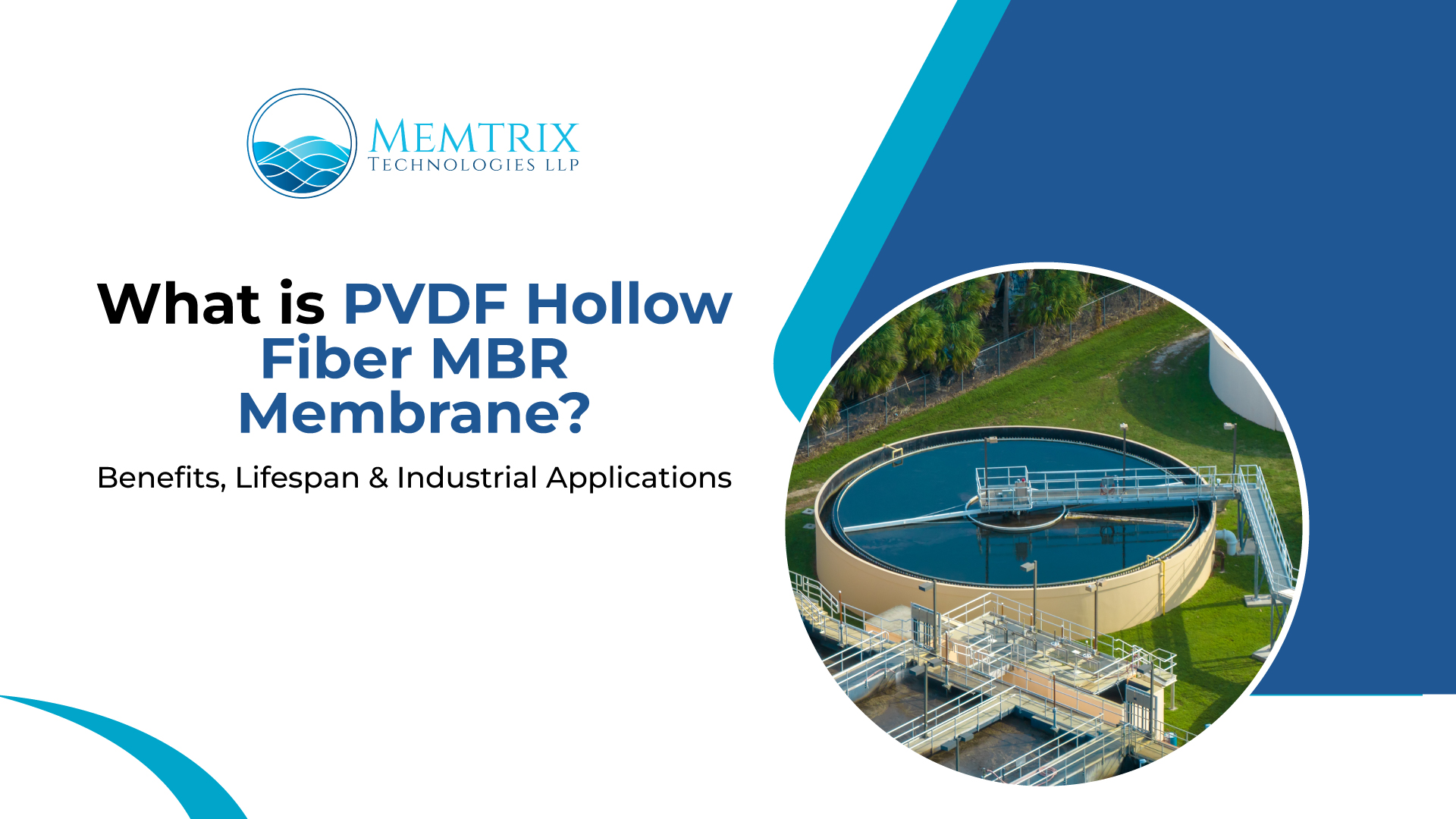
Choosing the right membrane technology for wastewater treatment can have a big impact on how well the system works, how much it costs, and how well it follows the rules. The PVDF hollow fibre MBR membrane is a strong part of membrane bioreactor (MBR) systems. This guide gives you all the information you need to know if you’re an engineer or technical buyer looking at options for PVDF membrane for wastewater treatment. It covers what it is, the benefits of MBR membranes, the lifespan of hollow fibre membranes, and the most important MBR membrane applications in industry.
We’ll look at the science, the specs, and how well it works in the real world to help you make smart choices.
Learning about PVDF Hollow Fibre MBR Membranes
The Fundamentals of Hollow Fibre Design
A PVDF hollow fibre MBR membrane is a type of microfiltration or ultrafiltration membrane made of polyvinylidene fluoride (PVDF) and shaped like thousands of thin, hollow fibres that are grouped together into modules. The inner diameter of each fibre is 0.5–1 mm, and the outer diameter is 1–2 mm. The pores are usually between 0.01 and 0.4 microns in size. This uneven structure lets water flow from the outside (lumen side) to the inside, where it is taken out as permeate.
In an MBR system, these membranes work with biological treatment: activated sludge breaks down organic matter while the fibres hold onto solids, bacteria, and even viruses. What makes PVDF appealing? It’s a semicrystalline thermoplastic polymer that is highly valued for its resistance to chemicals, strength, and water repellency. This makes it perfect for tough wastewater environments.
Hollow fibres have a higher packing density (up to 1,000 m²/m³) than flat-sheet membranes, which lets them fit into smaller spaces. They’re either submerged in the bioreactor or run in sidestream mode, with air scouring to keep them clean.
Why choose PVDF over other materials?
PVDF is more durable than polypropylene (PP) or polyethersulfone (PES). Its high beta value (the ratio of the thickness of the macrovoid-free skin layer to the total thickness) makes sure that the flux is even and that it can handle tensile stress. Some important specs are:
- Tensile strength: 50–60 MPa
- Break elongation: 20–50%
- The contact angle is between 80 and 90°, which means it is hydrophobic and less likely to get biofouled.
This means that the PVDF membrane for wastewater works well with feeds with up to 15,000 mg/L of total suspended solids (TSS).
Main Advantages of MBR Membranes
The benefits of MBR membranes are most clear in terms of efficiency and effluent quality. For strict rules like BOD <5 mg/L and TSS <1 mg/L, PVDF hollow fibre systems are the best choice.
Better effluent quality and a smaller size
Hollow fibres can cut down on bacteria by 6 logs, viruses by 4 logs, and almost completely remove particles larger than 0.1 μm. This makes it possible to reuse water in cooling towers or for irrigation, which is very important for businesses that have to follow EPA or EU rules about how much water they can release.
Compared to conventional activated sludge (CAS), the compact design cuts civil costs by 30% to 50%. A 1 MGD plant might only need 500 m², while a CAS plant needs 2,000 m².
Energy Efficiency and Resistance to Fouling
The latest PVDF fibres work at low pressure (10–30 kPa TMP) and have flux rates of 15–25 LMH (litres per square metre per hour). Air scouring at 0.3–0.5 m³ air/m² membrane/h gets the best shear without using too much energy (0.3–0.6 kWh/m³ permeate).
PVDF’s smooth surface and zeta potential (−20 to −40 mV at pH 7) make it less likely to get dirty. Studies show that it has 20–30% less irreversible fouling than PES, which means that cleaning cycles last longer.
Advantage of PVDF Hollow Fibre MBRThe footprint of a regular CAS is 50% smaller, and it has bigger lagoons and settlers.
Effluent BOD/TSS: less than 5 mg/L and less than 1 mg/L; 10 to 20 mg/L and 10 to 30 mg/L
Energy Use: 0.5–1 kWh/m³ or 0.3–0.5 kWh/m³ (but takes up more space)
Removing nutrients: 90% or more (with anoxic zones)70–80%
Savings on costs over time
PVDF MBR costs 20–40% more than CAS, but operating costs go down 15–25% because there are fewer chemicals and sludge to deal with (no clarifiers). For reuse projects, it takes 3 to 5 years to get your money back.
Hollow Fibre Membrane Lifespan: Factors and Actual Data
Buyers are most concerned about how long hollow fibre membranes last. If used correctly, they should last 5 to 15 years, which is much longer than early cellulose acetate modules (2 to 5 years).
Important Factors That Affect Longevity
- Keep the flux below 20 LMH and the scour intensity above 0.4 m/s to keep fouling under control. Every 1 to 3 months, a chemical clean (NaOCl 2,000 ppm + citric acid) keeps things in good shape.
- Feed Quality: High salinity (>5,000 mg/L TDS) or oils shorten life; pretreat oily wastewater with DAF.
- Operating Conditions: A TMP rise of more than 50 kPa means that the system is getting dirty; relaxing cycles (idle periods) can add 20% to the system’s life.
- Material Quality: Certified PVDF (like Kynar or Solef grades) doesn’t break down in water or oxidants.
There are two types of failure: fibre breakage (1–2% loss per year) or pinholes, which can be found using pressure decay tests (PDT) or integrity tests (diffusive air flow <10 mL/min/module).
Data on Performance
Field studies confirm durability:
- A reclamation plant in Singapore said that PVDF modules lasted for more than 10 years with 95% fibre integrity.
- In municipal MBRs, GE ZeeWeed (made of PVDF) lasts an average of 8 to 12 years, and the cost of replacing it is 10 to 15% of the original cost.
Factor: Best Range; Effect on Lifespan
TMP: 10 to 40 kPa; more than 50 kPa cuts life in half
Monthly cleaning is needed. If you don’t clean often, you lose 30% of the flux each year.
The age of the sludge (SRT) is 15 to 30 days. A shorter SRT makes fouling worse.
Temperature: <40°C >50°C speeds up degradation
Pro tip: Work with suppliers who offer warranties of 7 to 10 years and SCADA for remote monitoring for predictive maintenance.
PVDF Hollow Fibre MBR Membranes in Industry: MBR membranes are used in industries where space, quality, and dependability are important. PVDF is strong enough to handle industrial effluents with a lot of strength.
Wastewater from cities and towns
More than 2,000 MBR plants around the world treat more than 5 million m³ of water every day. PVDF hollow fibres are great for retrofits, like India’s urban upgrades that aim for zero liquid discharge (ZLD).
Processing Food and Drinks
For dairies and breweries, PVDF membranes for wastewater can handle high COD (5,000–20,000 mg/L) and fats. An Unilever plant cut its water use by 40% by reusing MBR, which removed 99% of TSS.
Petrochemical and Landfill Leachate Oily wastewater? PVDF doesn’t break down hydrocarbons. For ZLD in refineries, MBR comes before RO. It treats 10,000 mg/L COD to less than 50 mg/L.
Drugs and clothes
Strict rules say that MBR is needed for micropollutants. Hollow fibres remove 95% of the colour from textile dye effluents (colour >1,000 Pt-Co).
Industry Typical Influent COD (mg/L) MBR Outlet COD Best Feature
Food Processing: 5,000–15,000 <100; Sludge reduction: 50%
Petrochemical 2,000–10,000 <50Tolerance to oil
Landfill Leachate 10,000–50,000 <200Refractory organics Pharma 1,000–5,000 <30Getting rid of viruses
Case Study: A textile park in Gujarat, India, used PVDF MBR (10 MLD capacity) to meet CPCB reuse standards. It is expected to last 12 years and save 25% more energy than CAS.
New Trends and Tips for Choosing
Improvements like plasma-treated PVDF make things more hydrophilic, which cuts fouling by 15–20%. Hybrid MBR-IFAS systems make it easier for streams with a lot of ammonia to nitrify.
For people who want to buy:
- Ask for data on the distribution of pore sizes (narrow for sharp cutoffs).
- Look over the pilot tests: Scale the flux to 80% of the lab values.
- Figure out the LCI (life cycle index); it should be more than 10 years.
- Think about modularity for gradual growth.
Local innovators and suppliers like Veolia (Biothane), Suez (Memthane), and others offer PVDF options that meet ASTM standards.
In conclusion, put money into PVDF for wastewater solutions that will last.
The PVDF hollow fibre MBR membrane has the best MBR membrane benefits, such as a longer lifespan and more uses. Engineers who choose PVDF membrane for wastewater can be sure that it will be a good balance of cost, performance, and maintenance.
Are you ready to plan your next project? Use pilot data and lifecycle models to get the best return on investment.
Reach out to a certified Indian MBR manufacturer today—your profits will appreciate it.
Call us or whatsapp us at +91 6355038616
Follow . Share . Like
Additional Read
Reinforced PVDF MBR Membranes: High Durability Solutions for Advanced Wastewater Treatment
How Made-in-India MBR Membranes Can Save Your Plant 30-40% on Membrane Costs
PVDF MBR Membranes: A Reliable Solution for Modern MBR Plants