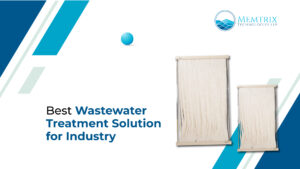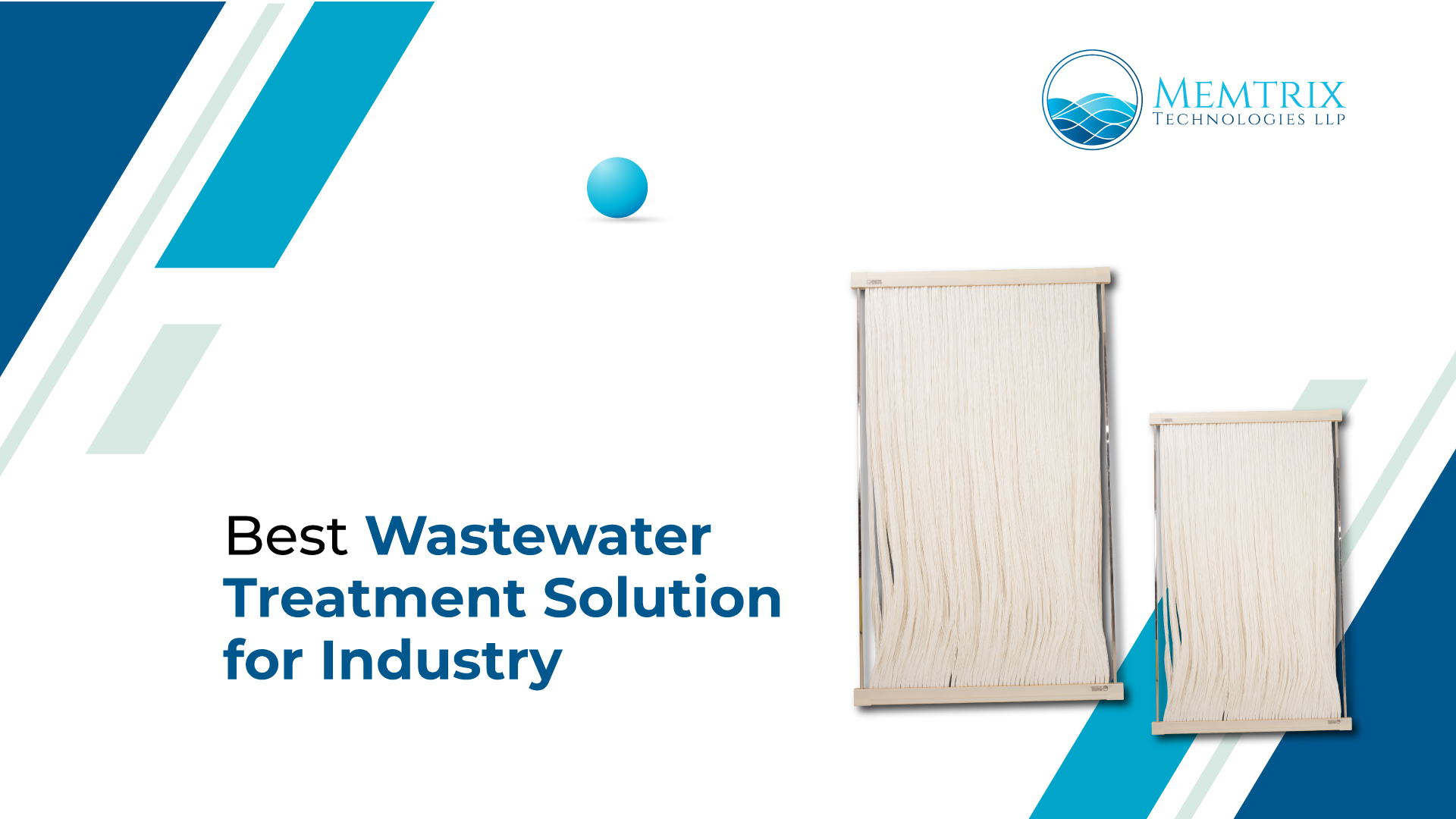
The best wastewater treatment solution for industry depends on wastewater quality, flow variation, discharge standards, land availability, reuse goals, and operating budget. There is no single treatment process suitable for every factory. However, Membrane Bioreactor technology has become a strong option for industries that require high-quality treated effluent, a compact footprint, reliable solids separation, and water reuse. MBR systems are particularly useful when conventional biological treatment alone cannot achieve the required effluent quality.
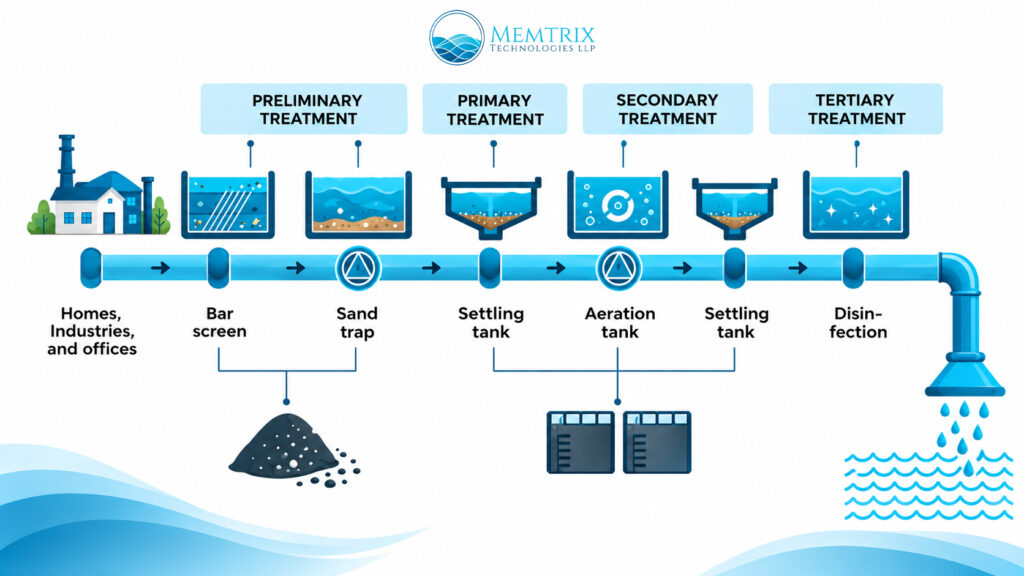
What Is an Industrial MBR System?
An industrial MBR combines biological treatment with membrane filtration. The biological stage removes biodegradable organic matter, while the membrane separates suspended solids, bacteria, and treated water.
A typical system may include:
1. Screening and preliminary treatment.
2. Equalisation tank.
3. pH correction.
4. Anaerobic or anoxic treatment, where required.
5. Aerobic biological reactor.
6. MBR membrane tank.
7. Permeate extraction.
8. Sludge wasting.
9. Disinfection or polishing.
10. RO and ZLD treatment, where required.
The membrane produces a consistent permeate that can be reused for cooling towers, floor
washing, toilet flushing, gardening, process utilities, or further polishing.
Why MBR Is Suitable for Industry
High-quality effluent MBR systems typically produce low-turbidity effluent with very low suspended solids. This makes the permeate suitable for reuse or as feed to downstream RO systems.
Compact footprint
Because the membrane replaces the secondary clarifier, MBR plants can occupy less space than conventional activated-sludge systems with separate clarification. This is valuable for established factories with limited available land.
Better solids separation
The membrane provides a physical barrier that is less dependent on settling characteristics. This can be useful when industrial wastewater produces poor-settling sludge or fluctuating biological conditions.
Water reuse
An MBR is often used as part of a broader Industrial Water Treatment Solution. When combined with RO, activated carbon, softening, advanced oxidation, or evaporator systems, it can support high-recovery water-reuse projects.
Reduced risk of suspended-solids carryover
Conventional clarifiers may experience sludge bulking or solids washout. MBR membranes provide a stronger separation barrier, although effective pretreatment and proper operation remain essential.
Industries That Use MBR
MBR systems can be designed for:
Textile and dyeing units.
Pharmaceutical manufacturing.
Chemical processing.
Food and beverage plants.
Dairy facilities.
Pulp and paper mills.
Automobile and engineering industries.
Hotels and commercial buildings.
Electronics and semiconductor facilities.
Industrial parks and common effluent treatment plants.
Each application requires a specific design. Textile wastewater, for example, may contain colour, salts, surfactants, and variable organic loading. Pharmaceutical wastewater may contain active compounds, solvents, and inhibitory substances. Pretreatment and biological testing are therefore important.
MBR Compared With Other Treatment Options Treatment
| Treatment technology | Main advantage | Main limitation |
| Conventional activated sludge | Familiar and comparatively simple | Larger footprint and variable solids separation |
| SBR | Flexible batch operation | Requires cycle control and may need polishing |
| MBBR | Robust biological treatment | Effluent usually requires clarification or filtration |
| MBR | Excellent solids separation and reuse-quality effluent | Higher membrane and aeration management requirements |
| RO | Excellent dissolved-solids removal | Requires effective pretreatment and produces reject |
| ZLD | Very high water recovery | High capital and energy consumption |
| ETP plus tertiary filtration | Flexible polishing options | Performance depends on multiple treatment stages |
MBR is not always the complete solution. For high salinity or dissolved contaminant removal, RO or other advanced processes may be required after the MBR stage.
Key Design Considerations
Wastewater characterisation
Accurate analysis is the foundation of successful design. The plant designer should assess flow, BOD, COD, TSS, ammonia, nitrogen, phosphorus, oil, grease, colour, salinity, toxicity, and temperature.
Pretreatment
Membrane protection requires appropriate screening and solids removal. Fibre, hair, plastic, lint, oil, and abrasive particles can cause fouling or physical damage.
Biological design
The biological system must be sized for organic and nutrient loads. Sudden changes in production can affect the microbial population and membrane performance.
Flux and membrane area
The design flux should reflect wastewater quality and operating conditions. A conservative design may improve reliability and membrane life.
Aeration and energy
MBR systems require aeration for both biological treatment and membrane scouring. Energy optimisation should include blower selection, dissolved-oxygen control, intermittent aeration, and efficient membrane cleaning.
Cleaning and maintenance
Operators should monitor transmembrane pressure, permeability, flux, turbidity, and chemical- cleaning requirements. Preventive maintenance is more economical than waiting for severe fouling or fibre damage.
Selecting the Right MBR Partner
An experienced MBR Membrane Manufacturer India like Memtrix Technologies or MBR Membrane Supplier should provide more than a membrane catalogue. The supplier should support:
Wastewater testing.
Pilot trials.
Process design.
Membrane selection.
System integration.
Automation.
Commissioning.
Operator training.
Performance monitoring.
Membrane replacement.
The project team should also calculate the complete lifecycle cost, including energy, chemicals, sludge handling, manpower, membranes, and disposal.
MBR as Part of ZLD and Reuse
For industries targeting Zero Liquid Discharge, MBR often serves as a biological and solids-removal stage before RO. The MBR reduces suspended solids and biodegradable pollutants, helping protect downstream membranes.
A typical reuse-oriented arrangement may include:
Screening → Equalisation → Biological treatment → MBR → RO → Reuse or ZLD polishing
The exact configuration depends on salinity, COD, hardness, silica, colour, and the required final
water quality.
Conclusion
MBR technology is one of the most effective industrial wastewater treatment solutions when a facility requires compact treatment, high-quality effluent, and water reuse. It can be integrated with RO, tertiary treatment, and ZLD systems to support more sustainable industrial operations.
The best solution is determined through wastewater characterisation, pilot testing, appropriate pretreatment, realistic membrane design, and reliable after-sales support. By working with a capable MBR Membrane Manufacturer India or MBR Membrane Supplier, industries can improve compliance, reduce freshwater demand, and create a more dependable water-management strategy.
Ready to take the next step towards better future? Consult our experts today!
Click here for location: https://maps.app.goo.gl/kj8TTUL64GBkwUh96
Call us or whatsapp us at +91 6355038616
Follow . Share . Like
Additional Read
MBR Membrane Price in India: Cost Factors, Estimates, and Buying Guide
How Water Recycling Systems Help Industries Reduce Operational Costs