Selecting the right membrane for a sewage treatment plant is one of the most crucial decisions in wastewater treatment design. The membrane you choose influences treatment quality, operating cost, energy use, maintenance frequency, and long-term system performance.
A suitable membrane helps the plant meet discharge standards consistently while also supporting water reuse goals. A poor choice can lead to frequent fouling, increased downtime, costly replacement cycles, and reduced overall efficiency.
Why membrane selection matters
The membrane is the main separation component in a membrane-based sewage treatment system. It determines how effectively solids, bacteria, and other contaminants are removed from wastewater.
For sewage treatment plants (STPs), selecting a membrane is not just about filtration capacity. It also involves matching the membrane to the wastewater characteristics, the plant’s hydraulic load, available space, operator skill level, and budget. In many projects, the difference between a reliable plant and a problematic one lies in choosing the right membrane technology from the beginning.
Membranes are used in applications such as membrane bioreactor (MBR) systems, ultrafiltration, and tertiary treatment for reuse. Each application requires a different balance of pore size, strength, cleaning tolerance, and operating conditions. That is why there is no single best membrane for every sewage treatment plant.
Main membrane types used in STPs
The most common types of membranes used in sewage treatment include hollow fiber membranes, flat sheet membranes, and tubular membranes. Each type has its strengths and limitations depending on the application.
Hollow fiber membranes are widely used in membrane bioreactor systems. They offer high packing density and strong filtration performance in a compact size. They are suitable for plants where space is limited and high treatment efficiency is needed.
Flat sheet membranes are known for their mechanical strength and are often preferred in systems where easier cleaning and durability matter. They can be a good option for wastewater streams with varying solids loading.
Tubular membranes are less common in standard sewage treatment plants but are useful for treating challenging wastewater with heavy solids or oil contamination. They are generally more rugged, but they may require more energy and have lower packing density.
Key factors to evaluate
Choosing the right membrane starts with understanding the wastewater and the goals of the plant. Select the membrane based on actual operating conditions, not just catalog specifications.
- **Influent quality:** Examine the characteristics of the wastewater, including suspended solids, COD, BOD, oil and grease, pH, temperature, and shock load potential. A membrane that performs well for domestic sewage may not work the same way for industrial wastewater.
- **Treatment objective:** Decide whether the plant is meant for discharge, reuse, or advanced treatment. Reuse applications generally require higher effluent quality and more stable performance.
- **Footprint constraints:** If the plant has limited space, compact membranes with high packing density are often preferred. This is why MBR membrane systems are popular in urban projects and retrofits.
- **Operating conditions:** Consider air scouring requirements, flow variations, chemical cleaning compatibility, and allowable transmembrane pressure. A membrane must handle the real-world operating stress of the plant.
- **Maintenance capability:** Some membranes need more frequent cleaning or careful process control. If the facility does not have highly skilled operators, a more accommodating membrane design may be better.
- **Budget and lifecycle cost:** The initial purchase price is just one part of the decision. Consider replacement frequency, cleaning chemicals, energy consumption, and expected membrane life.
Hollow fiber vs flat sheet
A common decision in STP design is whether to choose hollow fiber or flat sheet membranes. Both are effective but serve different priorities.
Hollow fiber membranes are usually selected for their compact design and high membrane area per unit volume. They are efficient for municipal sewage treatment and many industrial reuse systems. However, they can be more sensitive to fiber damage if the system is not operated properly.
Flat sheet membranes generally offer better physical durability and can be easier to inspect and clean. They are often chosen where sludge characteristics vary or where operators want a more robust system. The trade-off is that they may take up more space and have lower packing density compared to hollow fiber designs.
A practical way to choose between them is to determine whether your project values compactness and efficiency more or durability and ease of handling more.
Fouling and cleaning behavior
One major performance issue in any membrane system is fouling. Fouling occurs when solids, organic matter, biofilm, or scaling reduce membrane permeability and increase operating pressure.
The right membrane should be selected with fouling resistance in mind. This includes membrane surface properties, pore structure, material type, and the ability to withstand frequent cleaning. Some membranes recover performance better after chemical cleaning, while others may degrade faster with repeated cleaning cycles.
You should also think about the cleaning strategy. A membrane that performs well only under ideal conditions may not be suitable for a plant with fluctuating loads and limited operator attention. In sewage treatment, membranes must remain reliable even when incoming wastewater is inconsistent.
Membrane material and durability
Membrane material is another crucial factor. The most common materials include PVDF and other polymer-based options that balance chemical resistance, strength, and filtration performance.
Durability matters because sewage treatment plants operate continuously. They are exposed to biological activity, chemicals, and changing water quality. The membrane should tolerate regular backwashing, air scouring, and chemical cleaning without rapid degradation.
Material selection should also consider temperature range and chemical compatibility. If the plant uses aggressive cleaning agents or handles industrial wastewater with unusual contaminants, the membrane material must withstand those conditions over time.
Matching membrane to plant type
Different plants have different membrane needs. A municipal STP, a residential complex, a commercial building, and an industrial facility will not all need the same membrane configuration.
For municipal plants, reliability, ease of maintenance, and consistent effluent are typically the top priorities. Compact systems and low operating disruptions are especially valuable in urban installations.
For industrial wastewater plants, the membrane should be chosen with process variability in mind. Industrial influent can contain chemicals, higher solids, oils, or fluctuating load patterns, so the membrane needs strong resistance and careful pretreatment.
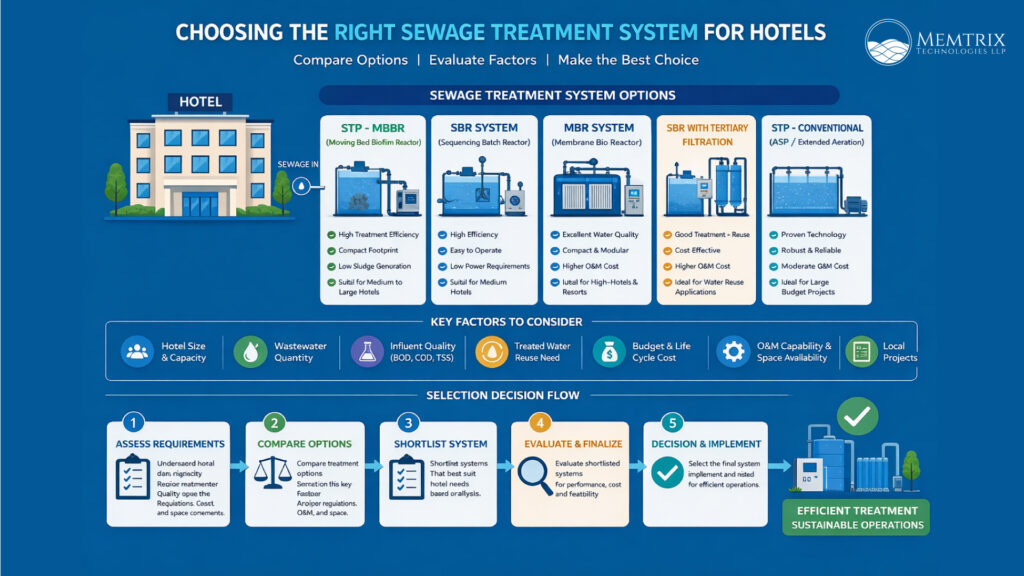
For decentralized or onsite STPs in apartments, hotels, and campuses, ease of operation and low maintenance often take precedence over complexity. In these cases, a membrane system should be simple enough for routine monitoring while still ensuring stable water quality.
Role of pretreatment
Pretreatment has a significant impact on membrane life and performance. Even the best membrane will struggle if wastewater enters the system with excessive grit, oil, fibers, or coarse solids.
Screens, equalization tanks, grit removal, and proper biological treatment all help protect the membrane. The better the pretreatment, the lower the risk of fouling and membrane damage.
When selecting a membrane, always consider the quality of upstream treatment. A robust membrane system can compensate for some variability, but it cannot make up for poor process design. Good pretreatment often reduces lifecycle costs more effectively than upgrading the membrane alone.
Cost versus long-term value
Many buyers focus too much on the initial price of the membrane. This approach can be misleading because membranes should be evaluated based on total cost of ownership.
A low-cost membrane may require more frequent replacement, more chemical cleaning, higher energy input, or more operator attention. Over time, these hidden costs can make it more expensive than a premium membrane that lasts longer and operates more efficiently.
A better approach is to consider lifecycle value. Ask how long the membrane is expected to last, how often it needs cleaning, what the chemical consumption will be, and how much downtime it may cause. The right membrane is the one that provides consistent performance at the lowest overall lifecycle cost.
Common selection mistakes
Many STP projects encounter problems due to rushed membrane selection. One common mistake is choosing a membrane based only on supplier claims instead of site conditions.
Another mistake is overlooking future load growth. If wastewater flow or contamination increases over time, the membrane should have enough margin to handle the change. Selecting a membrane that only fits today’s load can create issues later.
A third mistake is underestimating maintenance needs. Membrane systems are efficient, but they still require process monitoring, cleaning schedules, and periodic inspections. Choosing a membrane without considering operator capability often leads to early performance decline.
Practical selection checklist
Before finalizing a membrane, review this checklist:
– Clearly define the sewage characteristics.
– Confirm whether the plant is for discharge or reuse.
– Compare hollow fiber, flat sheet, and tubular options.
– Evaluate fouling resistance and cleaning compatibility.
– Check membrane material and chemical durability.
– Review pretreatment design and sludge handling.
– Estimate lifecycle costs, not just purchase price.
– Match the membrane to operator skill and maintenance resources.
– Verify supplier support, availability of replacements, and service response.
This checklist helps narrow the choice to membranes that are suitable for the project rather than simply available in the market.
Conclusion
Choosing the right membrane for a sewage treatment plant is both a technical and financial decision that impacts the system’s entire lifespan. The best membrane is not always the cheapest or the most high-tech; it should match the wastewater, plant design, maintenance capability, and treatment goals.
By considering influent quality, fouling risk, material durability, pretreatment, and lifecycle cost together, you can pick a membrane that offers stable performance and lasting value. This method results in better effluent quality, reduced operating risk, and a more dependable sewage treatment plant.
Ready to optimize? Consult a specialist for a free audit.
Click here for location: https://maps.app.goo.gl/kj8TTUL64GBkwUh96
Call us or whatsapp us at +91 6355038616
Follow . Share . Like
Additional Read
ETP vs STP vs MBR: Which Wastewater Treatment System is Right for Your Industry?
How MBR systems are changing the game for hotels and businesses that reuse wastewater
What is the PVDF Hollow Fibre MBR Membrane? Benefits, lifespan, and uses in industry