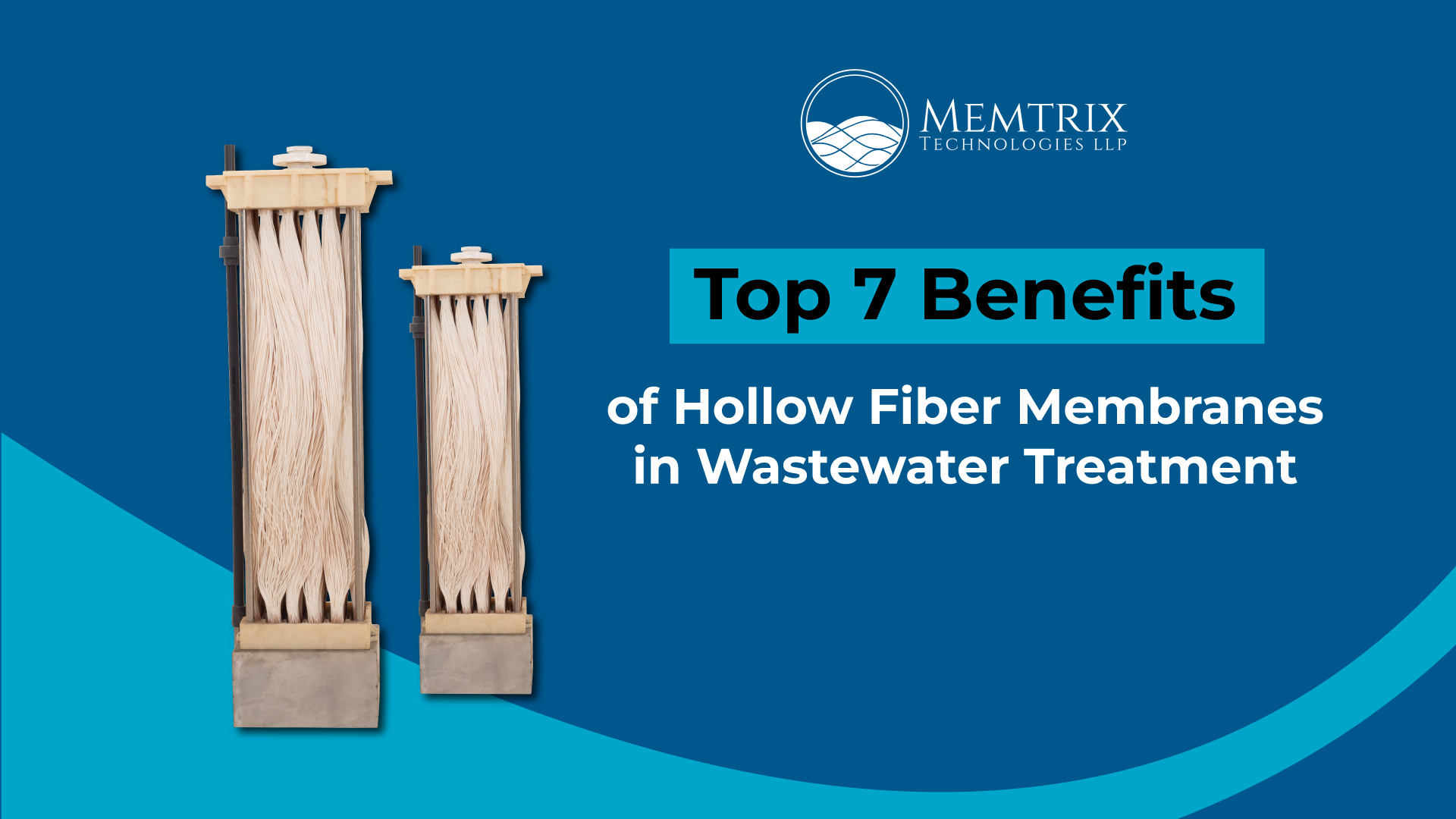
Hollow fibre membranes are among the most common membrane technologies in modern wastewater treatment. Their small size, high filtration capacity and good performance makes them a practical option for many sewage and industrial systems.
They are particularly popular in MBR systems because they provide efficient treatment and require less space than many other alternatives. Hollow fibre membranes offer a number of important benefits for applications where dependable water quality and efficiency are essential.
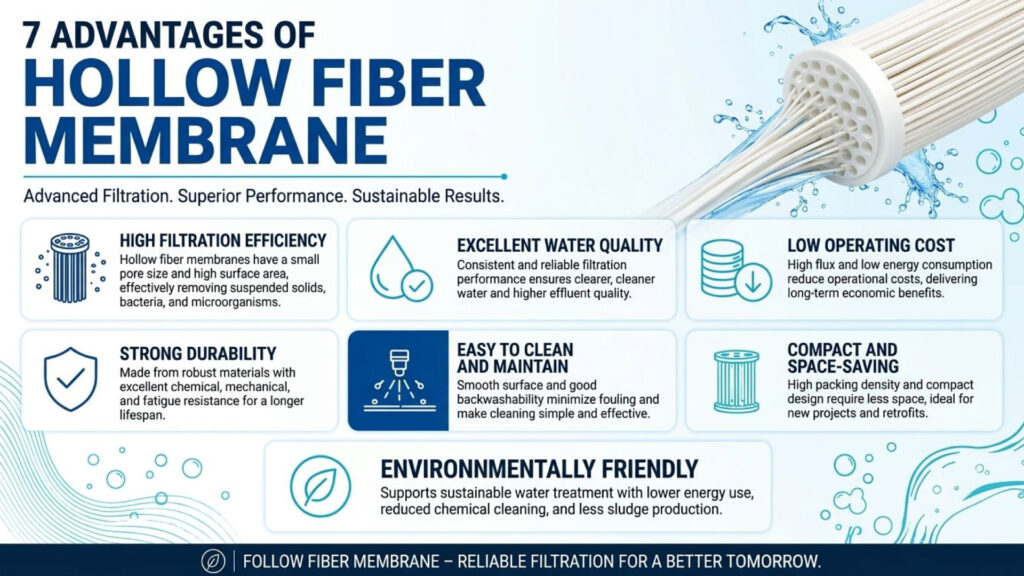
1. Compact space with large membrane area
A key advantage of hollow fibre membranes is their high packing density. The system is compact and space efficient because a large membrane area can be accommodated in a relatively small module.
This is especially useful in urban STPs, apartment complexes, commercial buildings and retrofit projects where space is a constraint. Hollow fibre systems can be very good performers in a smaller footprint, rather than needing a large footprint.
The compact design also reduces civil work and plant size, which can reduce project complexity. In many installations this makes hollow fibre membranes a practical and economic alternative.
2. High filtration efficiency
Hollow fibre membranes are great for separating solids and contaminants from wastewater. They have good filtration qualities and give uniform clearness to the treated water.
This makes them suitable for applications where effluent quality is important such as discharge and reuse. In many cases they can provide much better water quality than conventional treatment alone.
One of the reasons they are a preferred choice in membrane bioreactor systems is their ability to retain suspended solids, bacteria and other impurities. This is a great advantage for plants targeting stable high-quality output.
3. Supporting Effective Water Reuse
The reuse of water is becoming more and more important in municipal and industrial treatment. Hollow fibre membranes are reusable because they produce high-quality effluent suitable for non-potable use.
The treated water can then be reused for flushing, gardening, cooling, cleaning, landscaping or some industrial processes. Plants can reduce operating costs and improve sustainability by cutting dependence on freshwater.
With water scarcity increasing, this reuse capability becomes all the more valuable. Hollow fibre membranes are thus very important in modern water recycling strategies. Suitable for MBR systems
Hollow fibre membranes are widely used in membrane bioreactor configurations since they combine biological treatment and membrane separation in a single system. This leads to a compact and very efficient treatment process.
MBR technology is well known for producing excellent quality effluent in less space than many conventional systems. Hollow fibre membranes are particularly suitable for this process as they allow high flux and efficient solids separation.
It is a hard to beat combination for projects requiring advanced treatment in a smaller footprint. This is one of the big reasons why hollow fibre technology keeps growing in wastewater treatment.
5. Small footprint, simple integration
Hollow fibre membranes are compact, making them easier to retrofit into new or existing plants. This is useful when the space is limited or when an older plant is to be upgraded.
Smaller footprint systems can frequently be installed with less structural modification. This can reduce project time and make retrofits more practical.
That advantage is important where land is expensive, such as in cities, and where existing treatment sites have limited room for expansion. Hollow fibre membranes allow easy addition of advanced treatment with no major space change.
6. Good operational flexibility
Properly designed and operated hollow fibre membrane systems can handle variable wastewater loadings. This flexibility is useful in plants where the influent quality changes during the day or over time.
They are adaptable for municipal, residential, commercial and industrial application. The modular structure of them also enables scaling as treatment demand increases.
This operational flexibility allows plant owners to develop more resilient systems. That adaptability is often as important as raw filtration performance in real-world wastewater treatment.
7. Robust long-term value
Hollow fibre membranes can be of great long term value if the system is selected and maintained properly. The combination of small size, high efficiency and support for reuse can reduce the overall cost of treatment over time.
Membrane systems do need maintenance and periodic cleaning, but the value they offer often justifies the investment.” A smaller footprint, stability of effluent quality and improved potential for reuse may all contribute to better life cycle economics.
For many project owners the decision isn’t simply about the initial cost. It’s about picking a technology that’s reliable, supports compliance and provides value over the long term.
Important considerations
Hollow fibre membranes work very well, but they are not the best choice for every application. Their performance depends on proper pretreatment, operating discipline, cleaning schedules and wastewater characteristics.
If the influent has too much oil, grit, or coarse solids, the system may require more robust upstream treatment. Otherwise fouling and damage can cause performance degradation.
Buyers should also consider membrane material, air scouring requirements and maintenance requirements. Good design must balance performance with the practicalities of plant operation.
Where they are used commonly
Municipal STPs, residential societies, hotels, campuses and industrial waste water systems use hollow fibre membranes commonly. They are particularly valuable in applications requiring both compact design and high quality effluent.
They are also suitable for water reuse projects where a constant output is required for non-potable applications. In many cases they are a good compromise between efficiency and practicality.
This all-round applicability is part of the reason why they are still such an important technology in wastewater treatment.
The advantages of hollow fibre membranes are compact design, strong filtration, reuse support, MBR compatibility, and value for the long term. These benefits make them a good choice for many modern treatment plants.
With appropriate pretreatment and maintenance, hollow fibre membranes can reliably deliver high-quality treated water. They are one of the most efficient membrane options for projects that require limited footprint.
Follow . Share . Like
Additional Read
ETP vs STP vs MBR: Which Wastewater Treatment System is Right for Your Industry?
How to Choose the Right Membrane for Your Sewage Treatment Plant