India is entering a new phase in water management where sustainability is a necessity rather than an option. Growing water stress, industrial expansion, urbanization, and stricter environmental expectations push businesses and municipalities to adopt more efficient treatment systems.
The future of sustainable water treatment in India will focus on water reuse, energy efficiency, smart monitoring, and effective wastewater technologies. Facilities that can treat, recycle, and recover water while minimizing environmental impact will set the new standard.
Why sustainability matters now
India faces increasing pressure on freshwater resources because demand is rising faster than availability in many regions. Cities, industries, and agriculture all compete for the same limited supply.
At the same time, wastewater generation is increasing as urban populations grow and industrial activity expands. This makes traditional treatment insufficient. Sustainable treatment is needed to protect the environment and support long-term water security.
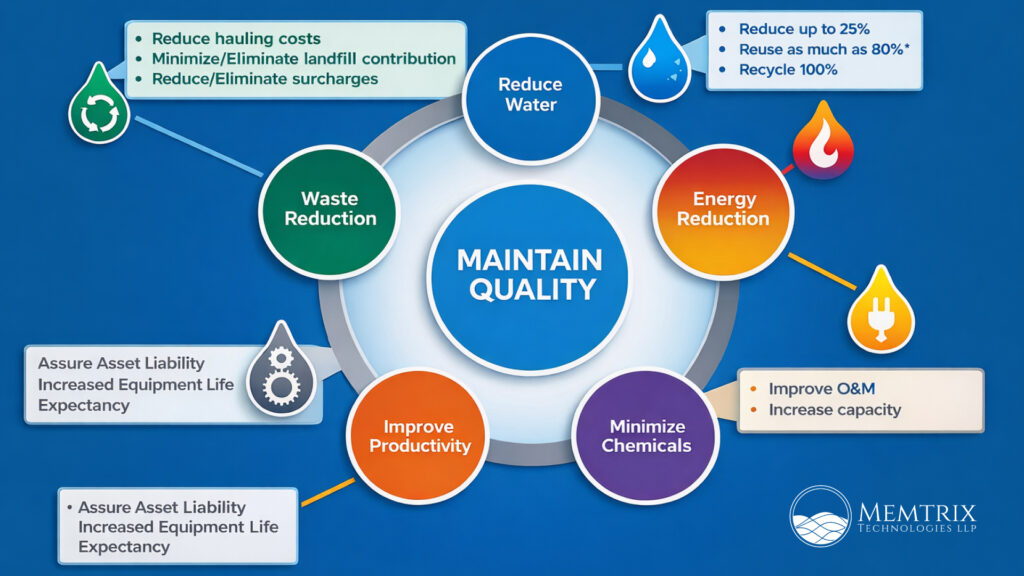
Sustainability in water treatment means using less energy, producing less waste, recovering more water, and reducing dependence on freshwater sources. This shift is already evident in new plant designs, industrial reuse projects, and city-level water strategies.
Water reuse will grow
One of the strongest trends in the future of water treatment is reuse. More facilities will treat wastewater to a standard that allows reuse in cooling, flushing, gardening, process applications, and even advanced industrial operations.
Water reuse helps reduce freshwater demand and lowers the cost of water procurement over time. It also supports environmental compliance by minimizing discharge volume.
In India, reuse will be especially important in water-stressed cities and industrial zones. As regulations tighten and water scarcity deepens, treated wastewater will increasingly be viewed as a usable resource rather than waste.
Membrane technologies will expand
Membrane-based systems will play a major role in the next generation of sustainable treatment. Technologies like MBR, ultrafiltration, and advanced membrane filtration offer high-quality treatment in compact designs.
These systems work well for both municipal and industrial plants because they can maintain consistent effluent quality even with varying influent conditions. They also support reuse, which is essential for sustainable water management.
As membrane prices become more competitive and local manufacturing improves, adoption will likely increase further. The focus will not only be on performance but also on durability, energy use, and lifecycle cost.
Energy efficiency will be a priority
Water treatment can be energy-intensive, especially when plants rely on pumping, aeration, and advanced filtration. In the future, energy efficiency will be a key criterion for choosing a treatment system.
Plants will be designed to lower power consumption through better process control, improved aeration strategies, efficient membrane operation, and automation. In large facilities, even small energy savings can create significant cost advantages.
Sustainable treatment is now about cleaning water and minimizing the energy footprint of that process. This will encourage engineers and plant owners to select technologies that balance treatment quality with operational efficiency.
Smart systems will transform operations
Digital monitoring and automation are becoming increasingly important in water treatment. Smart systems can track flow, pressure, turbidity, pH, chemical dosing, and membrane performance in real time.
This enhances plant reliability by allowing early detection of problems before they lead to expensive failures. It also helps operators optimize energy and chemical use, which supports sustainability goals.
In the future, more treatment plants in India will depend on remote monitoring, predictive maintenance, and data-based optimization. Smart operation will reduce downtime, improve efficiency, and simplify the management of complex systems.
Industrial adoption will increase
Industries face growing pressure to reduce water consumption and improve wastewater management. Sectors such as textiles, food and beverage, chemicals, pharmaceuticals, and manufacturing will continue to adopt sustainable treatment systems.
For industries, sustainable treatment provides both compliance and cost advantages. Reusing treated water decreases reliance on external supply, while better wastewater recovery reduces disposal volumes.
Many companies are also integrating sustainability into their brand and ESG strategy. Water treatment is becoming a visible part of corporate environmental responsibility, which will accelerate adoption of advanced systems.
ZLD will remain important
Zero Liquid Discharge will continue to be a key strategy for industries facing strict discharge rules or operating in water-stressed regions. ZLD systems aim to recover nearly all usable water while minimizing liquid waste.
Although ZLD can be expensive to install and operate, it remains relevant where water recovery is essential. It is particularly important for industries with high wastewater loads or limited discharge options.
The future of ZLD in India will likely focus on greater efficiency, lower energy use, and smarter integration with membrane systems, evaporation, and reuse technologies. The goal will be to make recovery more practical and less resource-intensive.
Local manufacturing will strengthen
India’s water treatment sector is likely to see stronger growth in domestic manufacturing of components, membranes, and treatment equipment. Local production can reduce costs, improve availability, and shorten replacement timelines.
This is important because imported systems often involve long lead times and higher prices. As Indian suppliers enhance quality and technical support, many buyers will favor locally manufactured solutions.
Stronger domestic manufacturing will also support customization for Indian water conditions, which can vary greatly by region and industry. Local relevance will be a significant advantage in the future.
Decentralized systems will gain ground
Large centralized plants will always be important, but decentralized treatment is expected to become more common. Smaller plants at the building, campus, or industrial site level allow wastewater to be treated closer to where it is generated.
This approach decreases reliance on external infrastructure and simplifies water reuse. It also enables smaller communities and facilities to manage wastewater with greater flexibility.
In India, decentralized systems are well-suited for housing projects, commercial complexes, industrial parks, and smart city developments. Their modular design makes them easier to expand and adapt over time.
Policy and regulation will shape growth
Government policy will play a major role in shaping sustainable water treatment in India. As water stress increases, regulations on discharge, reuse, and water efficiency are likely to strengthen.
Policy support can encourage investment in advanced treatment, while compliance pressure pushes industries to act more quickly. Incentives for reuse, recycling, and green infrastructure may also help expand the market.
The future will depend not only on technology but also on how strongly policy promotes responsible water management. Clear standards and consistent enforcement will speed up adoption across sectors.
Challenges ahead
Even with positive trends, several challenges remain. High capital costs, limited operator training, and inconsistent maintenance can still slow adoption.
Many facilities struggle with poor planning, where treatment systems are chosen without fully understanding wastewater characteristics or long-term operating needs. This can lead to underperformance and higher lifecycle costs.
To make sustainable treatment more effective, buyers need to look beyond installation costs and consider the total value of water recovery, energy savings, and operational stability. Training and service support will remain as crucial as the technology itself.
What the future looks like
The future of sustainable water treatment in India will likely combine reuse, membrane technology, smart monitoring, and energy-efficient design. Plants will become more compact, more automated, and more focused on water recovery instead of simple disposal.
Industries and municipalities that invest early in sustainable systems will be better prepared for rising water costs, stricter rules, and long-term resource pressure. Over time, sustainability will become the default expectation for modern water treatment.
The most successful systems will be those that provide clean water, reuse potential, lower operating costs, and reliable performance. This combination will define the next generation of water treatment in India.
Conclusion
Sustainable water treatment in India is moving toward a future built on reuse, efficiency, and smarter operations. As water scarcity and environmental pressure grow, advanced treatment systems will become essential for both cities and industries.
The winners in this shift will be organizations that see wastewater as a resource, not a burden. By investing in sustainable technology now, they can improve compliance, lower costs, and build long-term water resilience.
Click here for location: https://maps.app.goo.gl/kj8TTUL64GBkwUh96
Call us or whatsapp us at +91 6355038616
Follow . Share . Like
Additional Read
What is the PVDF Hollow Fibre MBR Membrane? Benefits, lifespan, and uses in industry
How MBR systems are changing the game for hotels and businesses that reuse wastewater
MBR Hollow Fiber Membranes: Working Principle, Benefits, and Industrial Applications