In India’s growing industrial landscape, managing wastewater goes beyond just meeting regulations; it’s a vital strategy. With stricter rules under the Environment Protection Act and increasing water shortages, decision-makers must choose between ETP, STP, and MBR. This comparison looks at the three systems, outlining their strengths, costs, and best applications to help you choose the right water treatment technology for your operations.
Whether you’re involved in food processing, chemicals, or manufacturing, selecting the right industrial wastewater solution can reduce costs, ensure compliance, and even transform waste into reusable resources. Let’s get into it.
Understanding the Basics: ETP, STP, and MBR Explained
Wastewater treatment systems differ based on their source and the type of contaminants. Here’s a brief overview:
- ETP (Effluent Treatment Plant): Made for industrial waste with chemicals, heavy metals, oils, and high BOD/COD levels. It applies physical, chemical, and biological methods to neutralize pollutants before discharge.
- STP (Sewage Treatment Plant): Focuses on domestic sewage from everyday activities—such as bathrooms, kitchens, and canteens. It deals with organic matter, pathogens, and nutrients through aerobic/anaerobic digestion.
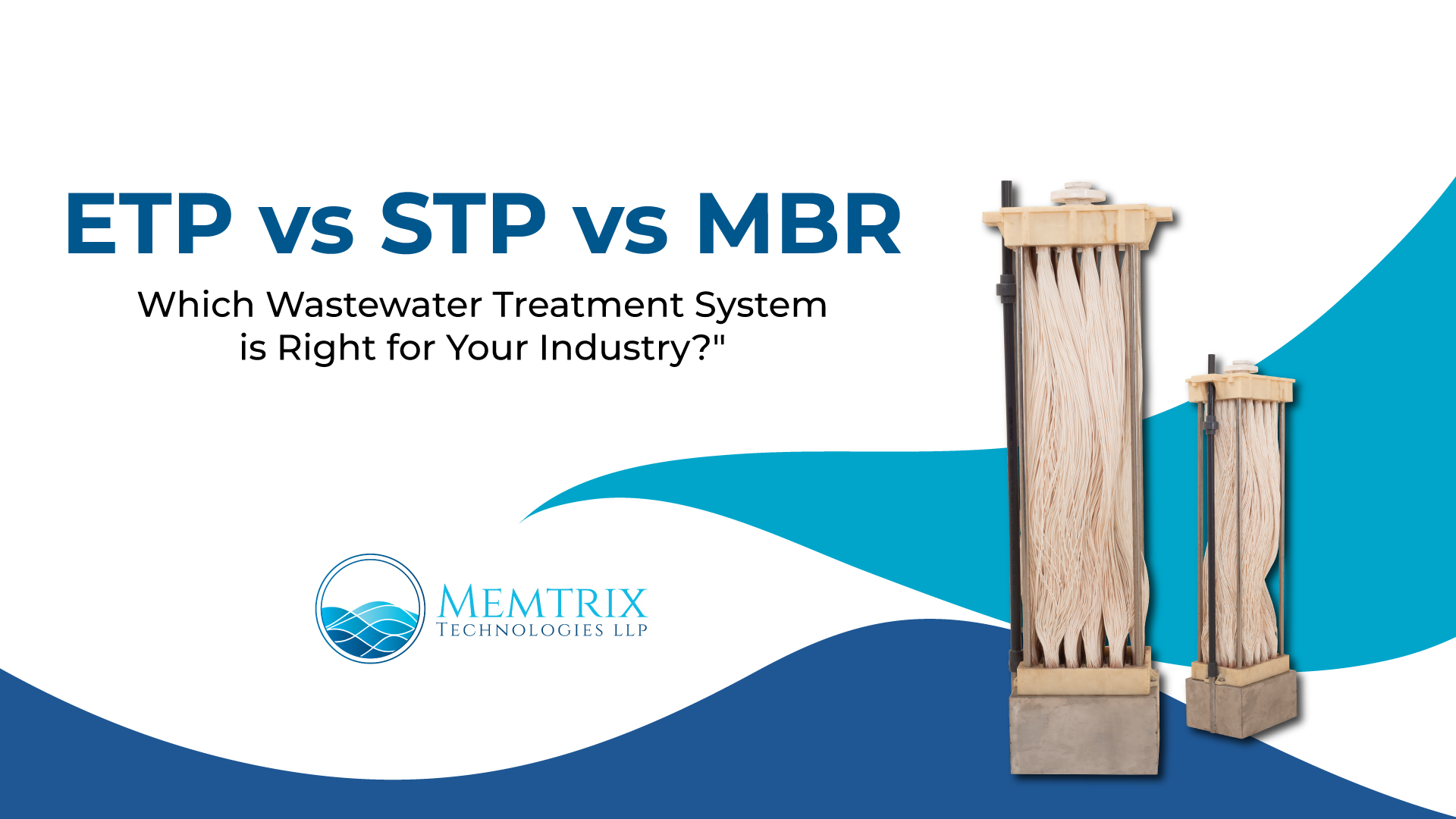
- MBR (Membrane Bioreactor): Combines biological treatment (like STP) with membrane filtration. It produces ultra-clean effluent suitable for reuse, making it a standout in water treatment.
When choosing between ETP, STP, and MBR, consider your wastewater’s source, volume, and goals—whether that’s discharge, reuse, or zero-liquid discharge (ZLD).
ETP: The Workhorse for Heavy Industrial Effluents
Effluent Treatment Plants are effective at handling toxic, heavy wastewater from factories. Common in industrial wastewater solutions in India, ETPs utilize a multi-stage process:
- Primary Treatment: Screening, grit removal, and oil skimming to remove solids.
- Secondary Treatment: Biological aeration tanks where microbes digest organics.
- Tertiary Treatment: Chemical treatment, flocculation, and filtration to remove color and odor, along with sludge dewatering.
Pros:
- Robust for varying loads (like textile dyes or pharma solvents).
- Cost-effective upfront: ₹5-15 crore for a capacity of 1 MLD.
- Meets CPCB standards for discharge into rivers or sewers.
Cons:
- High sludge generation (20-30% of inflow solids).
- Requires a larger area (0.5-1 acre per MLD).
- Effluent quality can vary; not suited for reuse without additional treatment.
For industries such as leather tanning in Kanpur or paper mills in Gujarat, ETP remains the preferred choice. A 2025 study by the Central Pollution Control Board (CPCB) indicates that 70% of Indian industries rely on ETPs for compliance.
STP: Reliable for Municipal and Domestic Wastewater
Sewage Treatment Plants excel in treating lower-strength, biodegradable waste from employee facilities or communities. Their processes mirror ETP but focus on biological efficiency:
- Activated Sludge Process (ASP): Air blowers provide oxygen to bacteria that digest organics.
- Extended Aeration: Slower but energy-efficient for smaller flows.
- Add-ons: Chlorination or UV for disinfection.
Pros:
- Simpler operations with lower chemical use.
- Capital cost: ₹3-8 crore per MLD.
- Generates reusable water for gardening or irrigation.
Cons:
- Struggles with industrial toxins (like phenols or pesticides).
- Sensitive to sudden loads, needing a consistent flow.
- Sludge management can still be a challenge.
In the wastewater treatment comparison, STPs suit factories with on-site accommodations or SEZs like those in Ahmedabad. They’re required for residential complexes according to Gujarat Pollution Control Board (GPCB) regulations.
MBR: The High-Tech Future of Wastewater Treatment
Membrane Bioreactor systems combine biological treatment with micro/ultrafiltration membranes (0.01-0.4 micron pores). Wastewater moves through a bioreactor, and membranes block solids, bacteria, and viruses.
Key Features:
- Compact Design: 70-80% smaller footprint compared to conventional systems.
- Superior Effluent: BOD <5 mg/L, TSS <1 mg/L—ready for reuse in cooling towers or as process water.
- Automation: PLC controls reduce operator errors.
Pros:
- Handles high MLSS (8,000-12,000 mg/L) for greater efficiency.
- Modular scalability; ideal for space-limited urban industries.
- Lowers ZLD costs by maximizing reuse.
Cons:
- Higher capital cost: ₹10-20 crore per MLD.
- Membrane fouling needs periodic cleaning (CIP).
- More energy-intensive (0.5-1 kWh/m³ compared to 0.3 for ETP/STP).
As MBR systems gain popularity in India, companies like Reliance Industries report a 90% water recovery rate. A FICCI Water Institute report in 2025 forecasts a 15% CAGR in the MBR market until 2030.
Head-to-Head: ETP vs STP vs MBR Comparison Table
For a clear view of ETP vs STP vs MBR, here’s a comparison:
| Parameter | ETP | STP | MBR |
| Ideal For | Industrial effluents | Domestic sewage | Mixed/reuse-focused |
| Effluent Quality | BOD 30-50 mg/L | BOD 20-30 mg/L | BOD <10 mg/L |
| Footprint (per MLD) | 5000 m² | 4000 m² | 1000-1500 m² |
| Capex (₹ Cr/MLD) | 5-15 | 3-8 | 10-20 |
| Opex (₹/m³) | 20-40 | 15-30 | 30-50 |
| Energy Use (kWh/m³) | 0.3-0.5 | 0.2-0.4 | 0.5-1.0 |
| Sludge Yield | High | Medium | Low |
| Reuse Potential | Low (needs polishing) | Medium | High |
| India Compliance | CPCB for discharge | GPCB for sewers | ZLD/ Reuse norms |
Data sourced from NEERI and industry benchmarks (2025).
Which is the Best Water Treatment Technology for Your Industry?
There isn’t a single answer—the best water treatment technology depends on your specific needs:
- Choose ETP if your wastewater contains heavy chemicals (like dyes and metals). It’s cost-effective for discharge-focused operations in SMEs.
- Pick STP for low-toxicity sewage in sectors like food processing or textiles with canteens.
- Go for MBR if you have space limitations or need to reuse water, especially in fields like pharmaceuticals and electronics. It’s future-proof amid India’s water issues, with groundwater depletion reaching 60% in Gujarat according to CGWB 2025.
Hybrid Tip: Many Indian facilities combine STP and MBR for separate streams, reducing overall costs by 20-30%.
Real-world example: A dye unit in Gujarat upgraded from ETP to an MBR-ETP hybrid system, reaching 80% reuse and saving ₹2 crore annually (case study: TERI, 2025).
Industrial Wastewater Solutions India: Regulations and Incentives
India’s push for sustainability raises the importance of these systems. Key regulations include:
- CPCB Effluent Standards: BOD <30 mg/L, COD <250 mg/L for most industries.
- GPCB/Gujarat Focus: Zero Liquid Discharge for textiles and pharmaceuticals in sensitive areas.
- Incentives: 20-30% subsidies under the NAMASTE scheme for MBR/STP upgrades.
With water demand expected to outstrip supply by 50% by 2030 (NITI Aayog), industrial wastewater solutions like MBR align with ESG goals, drawing investor interest.
Making the Switch: Costs, ROI, and Implementation Steps
Total Ownership Cost: ETP/STP typically break even in 3-5 years; MBR in 4-7 years when factoring in reuse savings.
ROI Boosters:
- Reuse reduces freshwater costs (savings of ₹50-100/m³).
- Sludge can be converted to biogas.
- Carbon credits are available under the PAT scheme.
5-Step Implementation:
- Conduct a wastewater audit (COD/BOD analysis).
- Perform a feasibility study (consult NEERI/Clean Max).
- Select a vendor (e.g., VA Tech Wabag, Thermax).
- Obtain the necessary permits (GPCB/CPCB NOC).
- Train staff on operations and maintenance with IoT monitoring.
Conclusion: Pick Your Winner in ETP vs STP vs MBR
In the ultimate wastewater treatment comparison, ETP suits heavy industrial waste, STP handles domestic sewage basics, and MBR leads in efficiency and reuse. For manufacturers in Gujarat facing issues with space and water, MBR often stands out as the best water treatment technology.
Evaluate your inflows, budget, and goals, then take action. Sustainable water management is essential for staying competitive.
Ready to optimize? Consult a specialist for a free audit.
Click here for location: https://maps.app.goo.gl/kj8TTUL64GBkwUh96
Call us or whatsapp us at +91 6355038616
Follow . Share . Like
Additional Read
How MBR systems are changing the game for hotels and businesses that reuse wastewater
How Made-in-India MBR Membranes Can Save Your Plant 30-40% on Membrane Costs