Budgeting for a new wastewater facility or a facility upgrade is one of the most financially complex decisions that a facility manager or environmental engineer will ever make. When you’re looking at the range of advanced treatment options, MBR is invariably the one that’s recommended. The reasons are obvious in terms of the effluent quality and the very small footprint it occupies. The first
question that always comes up though is the cost.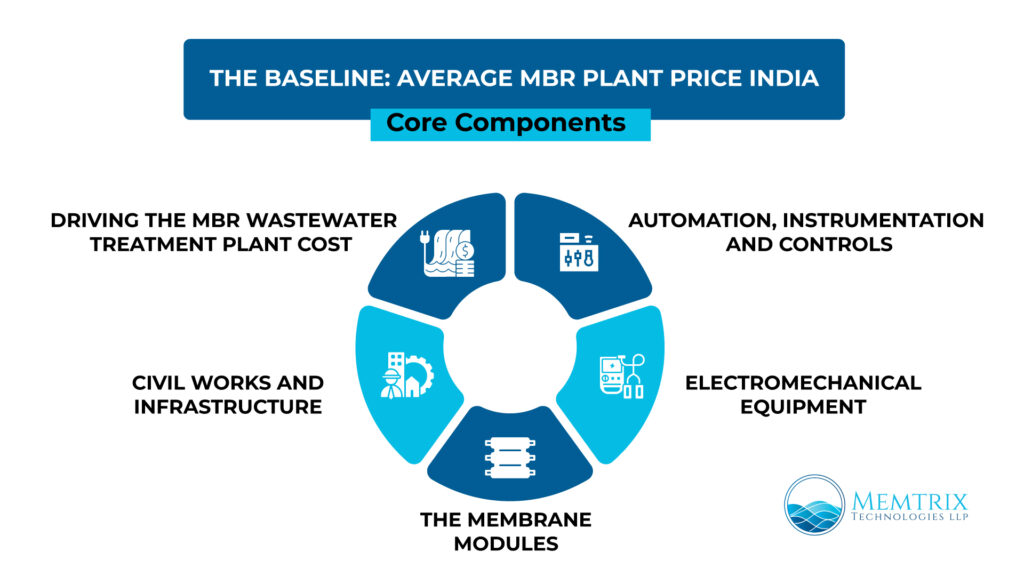
The cost is very much dependent on your particular feed water, the size of the plant and the end use of the treated water. In the Indian industrial and municipal environment where the ZLD (Zero Liquid Discharge) regime is becoming increasingly stringent, knowing what the MBR plant price India is going to be is absolutely vital to proper financial planning and to securing a good ROI.
This guide takes you through every single element that goes to make up the final price tag, from the initial CAPEX through to the ongoing OPEX, giving you a very clear and realistic picture of what the total MBR system cost will be in India.
The Baseline: Average MBR Plant Price India
To cut to the chase you need benchmark figures before you get into the detailed engineering. In India the MBR plant cost is generally based on installed capacity (in KLD or MLD). For a standard STP (designed for domestic/municipal wastewater) the initial capital cost is generally
in the range of ₹35,000 to ₹60,000 per KLD of installed capacity. So if you’re looking at a 100 KLD plant for a residential complex or a commercial tech park, your baseline MBR plant price in India will be somewhere between ₹35 Lakhs and ₹60 Lakhs.
If you are building an ETP for industrial wastewater the pricing is very different. The industrial effluents from the various sectors (textiles, pharma, chemicals etc) are very complex and contain a great deal of toxic, recalcitrant organics. You need chemical resistant membranes, longer HRTS and much more robust electromechanical equipment. The MBR WTP cost for an industrial ETP can therefore be anywhere from Rs 60,000 to over Rs 1,20,000 per KLD depending on the exact COD and BOD of the raw effluent.
It is also worth mentioning the scale of economies. A massive 5 MLD municipal project will have a vastly lower per litre cost than a very bespoke 50 KLD package plant which is going to be designed for a very specific, tight basement footprint.
Core Components Driving the MBR Wastewater Treatment Plant Cost
To properly understand where your budget is actually going you have to break down the CAPEX into the primary engineering disciplines. An MBR plant is a very tightly integrated system of civil, mechanical and electrical engineering.
Civil Works and Infrastructure
In a conventional Activated Sludge Process plant the civils are the big bit of the bill as you are building massive primary clarifiers, massive aeration basins and massive secondary clarifiers. With MBR you dont need the secondary clarifiers at all as the membrane module does the separation.
This obviously reduces the land footprint enormously (by as much as 50% in many cases) but the civil works that are left (the equalisation tank, the anoxic tank and the membrane bioreactor tank itself)
all have to be of very high standard. The civil works typically represent 20-30% of the total MBR plant cost. If you go with a pre-fabricated packaged MBR plant (in a modified shipping container or in a pre-fabricated MS/FRP tank) the on-site civil works cost is effectively zero, the mechanical fabrication cost is of course much higher.
The Membrane Modules
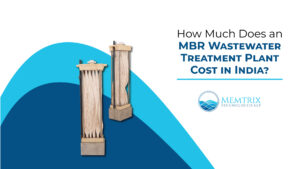
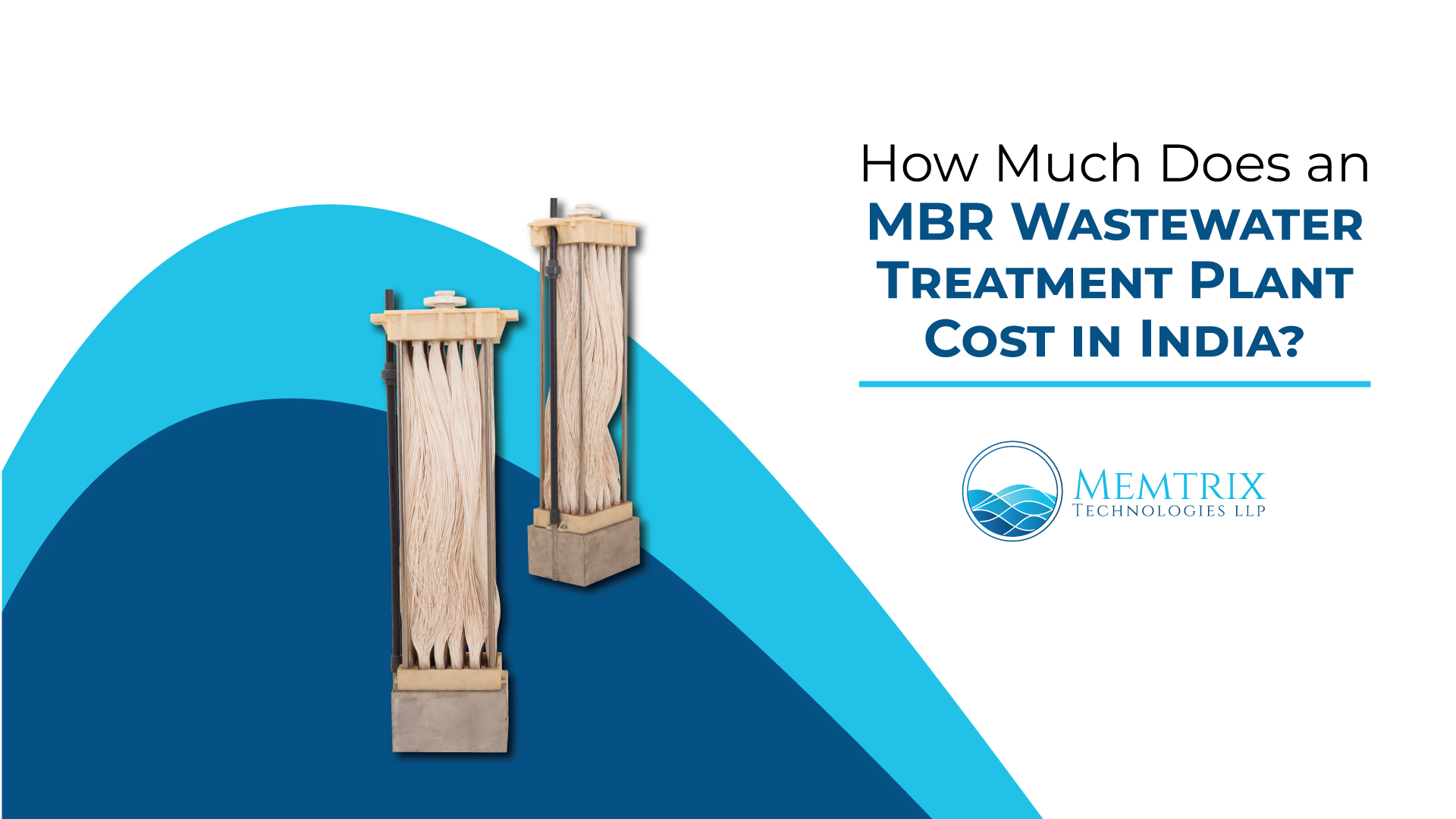
The membrane is the key element of the system and is by far the largest single piece of technology in the system. Whatever type you go for (flat sheet or hollow fibre) the membrane itself will be 20- 40% of the initial MBR system cost in India.
Imported polymeric membranes (PVDF, PTFE etc from the global brands) are of course a premium as you are paying import duty and all the currency fluctuations. The emergence of very good quality domestic manufacture has made the local option far more viable though. When you are looking at the cost of that component of the MBR plant you are paying for the membranes durability, its resistance to chemical fouling and its pore size distribution. If you cut corners and go for some cheap unbranded membrane you are going to have catastrophic fibre breakage and a very rapid replacement cost which will completely negate any initial savings.
Electromechanical Equipment
MBR systems are very much reliant on good mechanical movement and good air scouring. You need high efficiency blowers in the aeration tanks to keep the biological process going and specialised membrane blowers to scour the membrane surfaces to prevent sludge from plugging the pores. You also need permeate pumps (to pull the water through the membranes), sludge recirculation pumps and dosing systems for chemical cleaning.
The quality of the pumps and blowers has a massive bearing on the MBR plant price in India. If you go for high quality, energy efficient blowers (turbo or rotary lobe for instance) your CAPEX will be higher initially but your monthly electricity bill will be dramatically reduced.
Automation, Instrumentation, and Controls (PLC/SCADA)
An MBR plant is a very sensitive, automated process and is very different to the older ASP plants which can be run to a large extent manually by the plant operators. It’s a process which has to be constantly monitored with regard to TMP, DO and flow. If the TMP gets too high the PLC has to automatically initiate a backwash or a relaxation cycle.
Advanced instrumentation, automated pneumatics and SCADA systems are all part of the package to ensure the plant operates efficiently and to protect the very expensive membranes from irreversible fouling. The automation layer itself will typically represent 10-15% of the total MBR plant cost and is absolutely essential to the life of the system.
Operational Expenditure (OPEX)
The Long-Term MBR System Cost India A classic procurement trap is to look at the capital cost of the plant and nothing else. The real cost of
the plant is to be found in its OPEX. The MBR plant will have a higher capital cost than a conventional plant but a well designed plant will deliver a very efficient OPEX.
Power Consumption
Energy is by far the biggest ongoing cost in the MBR system in India. The membranes have to be constantly air scoured to prevent sludge build up and as such the aeration blowers are running all the time. A typical MBR plant will use between 0.8 and 1.5 kWh of electricity per cubic metre of treated water. Facility managers will need to incorporate local commercial electricity rates into their monthly budget forecast if they are to get a realistic picture of the long term cost.
Chemical Cleaning in Place (CIP)
To keep the membranes permeable they need regular chemical cleaning. Sodium hypochlorite is dosed to remove the organic fouling and then either citric or oxalic acid is used to remove the inorganic scale. The cost of these commercial chemicals isn’t massive but it does add a consistent monthly charge to the running costs.
Membrane Replacement
There’s no such thing as a membrane that will last forever. Even with the most careful maintenance the physical pores of the membrane will eventually become irreversibly fouled or structurally degraded. Most high quality PVDF membranes will last between 5 and 7 years. You have to amortise the cost of a full membrane replacement over that period. It is absolutely essential to have a sinking fund in place for membrane replacement so that you are not caught completely unawares by a huge capital requirement a few years down the line.
Key Factors That Fluctuate the MBR Plant Price India
If two companies build a 500 KLD plant their costs could still be very different by 30%. Several contextual variables heavily influence the final numbers:
• Influent water quality: high levels of COD, oil & grease or heavy metals all require significant pre-treatment (Dissolved Air Flotation or fine bar screens etc). Poor pre-treatment will destroy an MBR membrane in months. The inclusion of such rigorous pre-screening will of course add to the overall cost of the MBR plant.
• Discharge and reuse norms: if you are just looking to meet the basic municipal discharge standards then the system can be designed with a standard flux. If on the other hand you’re aiming for true Zero Liquid Discharge (ZLD) where the MBR permeate is going straight into an RO system for high grade factory reuse then the MBR has to be specified to very high tolerances and that will of course increase the price.
• Site and space constraints: when you’re short of land you’re going to have to go with a very vertical or very bespoke layout. Getting the complex electromechanical equipment into a basement or a piece of land that’s not quite the standard shape is going to require a lot of custom fabrication and a lot of bespoke safety systems which will of course drive up the MBR plant price in India.
Evaluating the Return on Investment
The MBR wastewater treatment plant cost is of course higher than that of a conventional activated sludge or SBR, but the premium is more than justified by the actual returns it produces. The real estate savings are huge. In the key industrial states of Gujarat, Maharashtra and Tamil Nadu land costs are absolutely astronomical. By halving the footprint you save crores in real estate (in many cases this will completely offset the higher MBR plant cost).
Secondly the quality of the treated water is such that it’s completely recyclable. Rather than pay the local water authority for fresh water to use in cooling towers, boiler feeds or floor washing you can close the loop and recycle your own wastewater. That eliminates the need for any fresh water intake and results in massive savings in raw water costs with a very rapid payback on a monthly basis.
To work out your exact MBR system cost in India you need a full treatability study and a full engineering design. Once you understand the key cost drivers you can move beyond the generic price quotes, assess vendor proposals properly and go in to build a system that is truly robust in
terms of its operational performance and its compliance with environmental regulations.
Ready to take the next step towards better future? Consult our experts today!
Click here for location: https://maps.app.goo.gl/kj8TTUL64GBkwUh96
Call us or whatsapp us at +91 6355038616
Follow . Share . Like
Additional Read
Best Wastewater Treatment Solution for Industry: Why MBR Technology Is a Strong Choice
Indian vs Imported MBR Membranes: Which Is Better for Indian Industries?
MBR Membrane Price in India: Cost Factors, Estimates, and Buying Guide