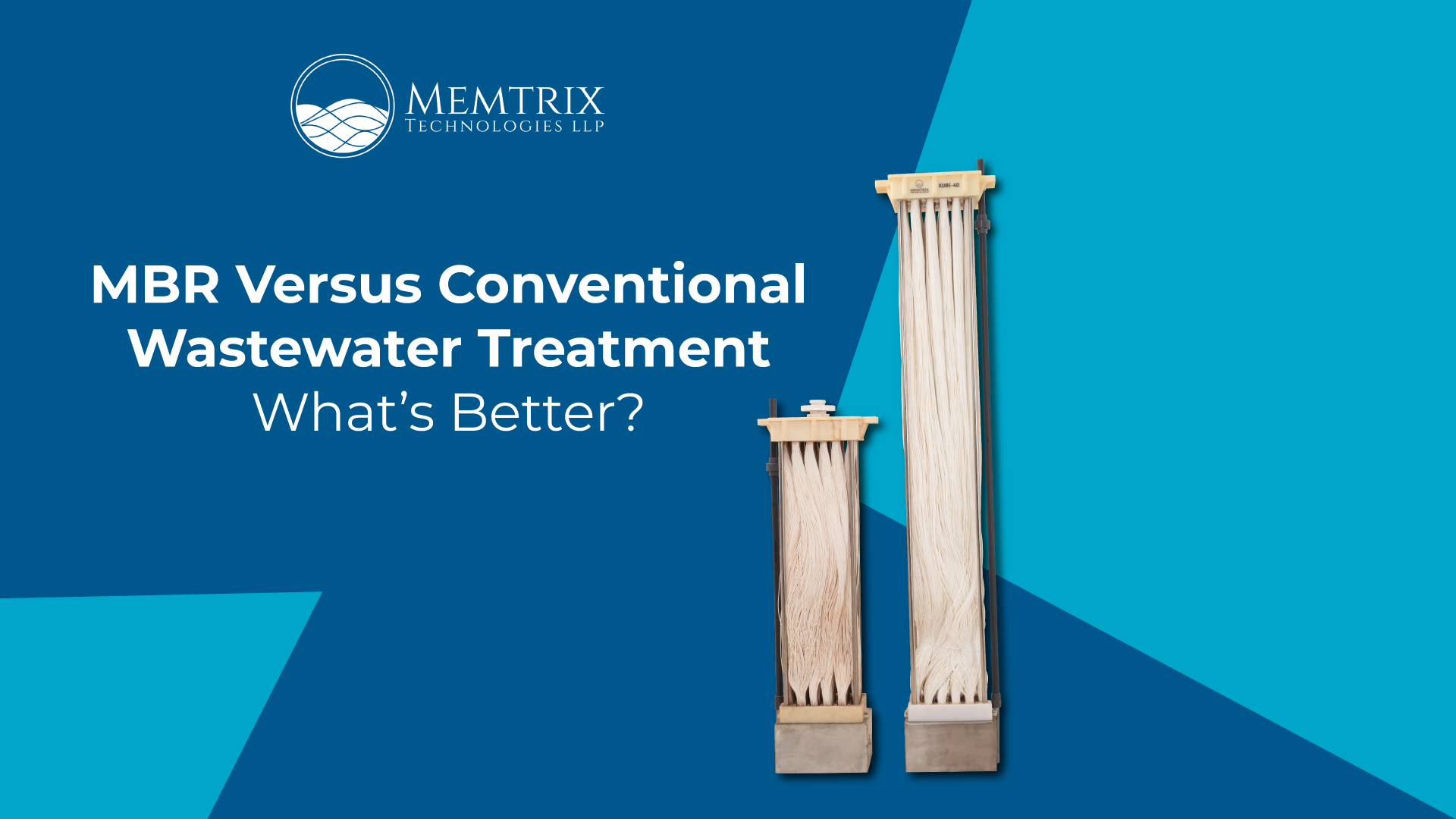
MBR or conventional wastewater treatment is selected based on treatment goal, space availability, operational budget, and water reuse needs. Generally, MBR systems are preferred when the highest effluent quality and a small footprint are most important. Conventional treatment can be a better fit when upfront cost and simplicity are the highest priorities.
Each system has clear advantages, but they are addressing different questions. The better choice is that which matches the real operational needs of the plant.
What is traditional wastewater treatment?
Conventional wastewater treatment generally involves physical, biological and sometimes chemical processes to remove pollutants from sewage or industrial effluent. Typical steps include screening, de-gritting, primary settling, aeration, secondary clarification and disinfection.
This is a method that has been around for decades, and is still common in many plants, as it is familiar and relatively straightforward. It has a broad application spectrum and is often chosen where land is available and treatment goals are moderate.
But standard systems tend to be more space demanding and can produce effluent quality that is not always suitable for direct reuse, without further polishing. Also, their performance depends strongly on clarifier efficiency and process stability.
What is MBR therapy?
MBR is short for membrane bioreactor. It combines biological treatment and membrane filtration, eliminating the need for a conventional secondary clarifier by employing a membrane separation stage.
This arrangement allows the system to hold biomass more efficiently and produces a much clearer effluent. The membrane acts as a very fine barrier, removing suspended solids and a large number of pathogens more efficiently than conventional systems.
MBR systems are commonly used when space is limited or when the treated water needs to be of a high quality for reuse. They are especially well suited to urban, commercial, and industrial uses.
Comparison of effluent quality
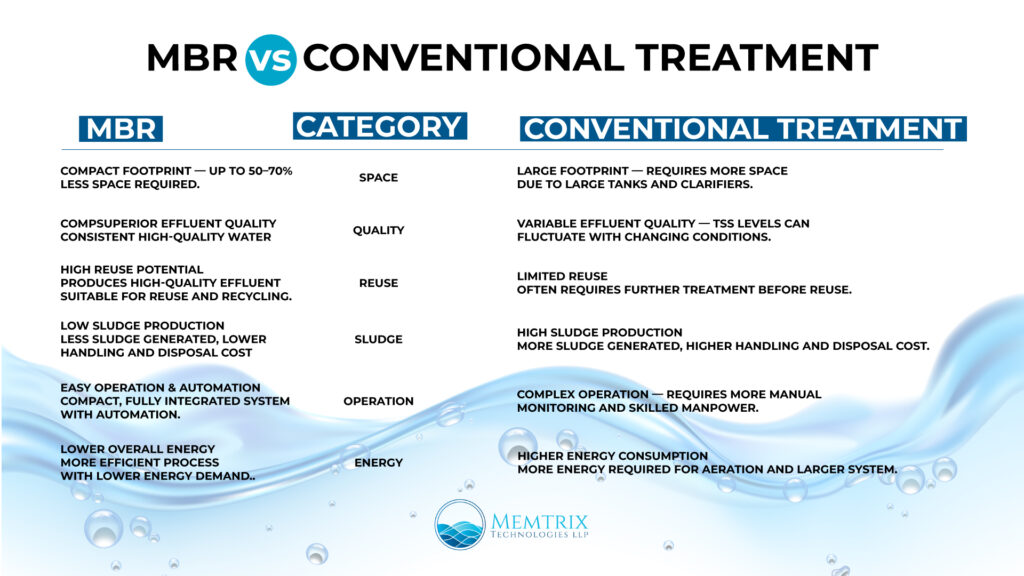
The effluent quality is one of the major differences between the two systems. Typically, MBR systems generate cleaner and more uniform treated water than conventional plants.
The MBR has the advantage of removing suspended solids and achieving low turbidity due to the membrane barrier. This improves the MBR suitability for reuse applications and sites with more stringent discharge standards.
Conventional treatment can meet many discharge requirements but process control is more critical and tertiary treatment may be required to obtain the same clarity. In general, MBRs have the advantage of high effluent quality. ## Footprint and space requirements
Space requirement is another big factor. Typical conventional plants require larger tanks, clarifiers and civil works.
MBR systems are also much more compact as they combine biological treatment and filtration in a smaller footprint. This makes them perfect for sites where land is scarce or expensive.
The smaller footprint of MBR can be a major advantage for urban projects, retrofits and decentralised treatment plants. This is one of the strongest reasons for choosing MBR over conventional treatment in many real-world projects.
Cost of operation and energy usage
In some cases, traditional wastewater treatment is easier and may use less energy. And as no membrane filtration is used, there is no need for membrane aeration and cleaning.
MBR systems tend to use more energy as membranes require air scouring and periodic cleaning. Eventually they will need replacement membranes, adding to the lifecycle costs.
However, MBR can be cost-effective where high effluent quality, reuse and space savings are important. The total cost should be evaluated over the life of the plant, not just the initial installation.
Complexity and maintenance
Conventional systems tend to be more user friendly and easier to operate, particularly in plants with a limited number of technical personnel. They employ the well known treatment processes and they do not include membranes requiring special cleaning and monitoring.
MBR systems are more advanced and need more process control. Operators have to be more careful about membrane fouling, trans-membrane pressure, cleaning cycles and airflow.
That is not to say that MBR is difficult to run, but it does require better training and more disciplined operation. If the plant team lacks technical support, conventional treatment may be the safer route.
Potential for reuse
MBR really shines in water reuse applications. The treated water is much cleaner so it can be reused more easily for flushing, irrigation, cooling and some industrial uses.
In conventional systems, additional filtration or polishing may be needed before reuse. This adds equipment, cost and complication.
If reuse is in the project plan, MBR is often the better long-term option. It makes the road to higher-quality reclaimed water easier.
Sludge treatment
The production and handling of sludge is also different in the two systems. Conventional plants produce sludge that requires settling and handling in dedicated clarifiers and sludge treatment units.
MBR systems can retain higher biomass concentration in the reactor, which favours efficient treatment and can alter the sludge characteristics. But the sludge treatment is a critical part of the overall design.
Both systems require sludge management, but the MBR can often provide better control over the biological process. Good sludge handling design is necessary in either cases.
Stability of reliability and performance
The conventional treatment can be reliable if influent conditions are stable and the plant is properly designed . However, clarifier performance and settling characteristics can vary, especially with load changes or difficult wastewater.
MBR systems generally provide a more stable effluent quality since membrane separation is less dependent on settling. This makes them more robust to changes in biomass properties.
That stability is a big plus for plants with variable loads or strict discharge requirements. That’s one reason MBR is often the treatment of choice for modern projects.
First cost comparison
The capital cost is usually less in conventional treatment. The equipment is less complicated and the process does not require membrane modules and associated systems.
MBR generally has a higher capital cost due to the membrane equipment, controls and supporting infrastructure. This extra capital cost may be an issue for budget sensitive projects.
However the higher investment might be justified by the lower footprint, better effluent quality and reuse potential. The answer depends on which is more important: the lower initial costs of the project or the greater capability in the long run.
Which one is best?
There is no single winner in the debate between MBR and conventional wastewater treatment. MBR is usually the better choice for plants requiring a compact design, high effluent quality and reuse potential.
When the upfront cost is less, the operation is simpler and the plant team already understands the system well, conventional treatment is often better. Where land is available and re-use is not a major objective, it may also be appropriate.
A practical way to decide is to ask three questions. How much space is there? What effluent quality is needed? How critical is reuse? The answers generally give quite clear indications of one system or the other.
Conclusion
Modern water management includes MBR and conventional wastewater treatment. Conventional treatment is simple and has lower upfront cost, while MBR offers better effluent quality, smaller footprint and stronger reuse potential.
If long term performance and water reuse is the focus MBR is usually the better choice. For smaller plants with tighter budgets and more space, conventional treatment can still be the right answer.
Ready to take the next step towards better future? Consult our experts today!
Click here for location: https://maps.app.goo.gl/kj8TTUL64GBkwUh96
Call us or whatsapp us at +91 6355038616