In today’s competitive industrial environment, wastewater treatment is more than just a compliance requirement; it directly impacts your profits. For procurement managers looking for deals, CFOs calculating expenses, and plant operators ensuring efficient systems, the cost of MBR membranes in India has become critical. Membrane Bioreactor (MBR) systems use hollow fiber membranes to filter out contaminants at a microscopic level, providing high-quality effluent for Effluent Treatment Plants (ETPs). However, imported membranes often raise costs, tying up resources in pricey replacements.
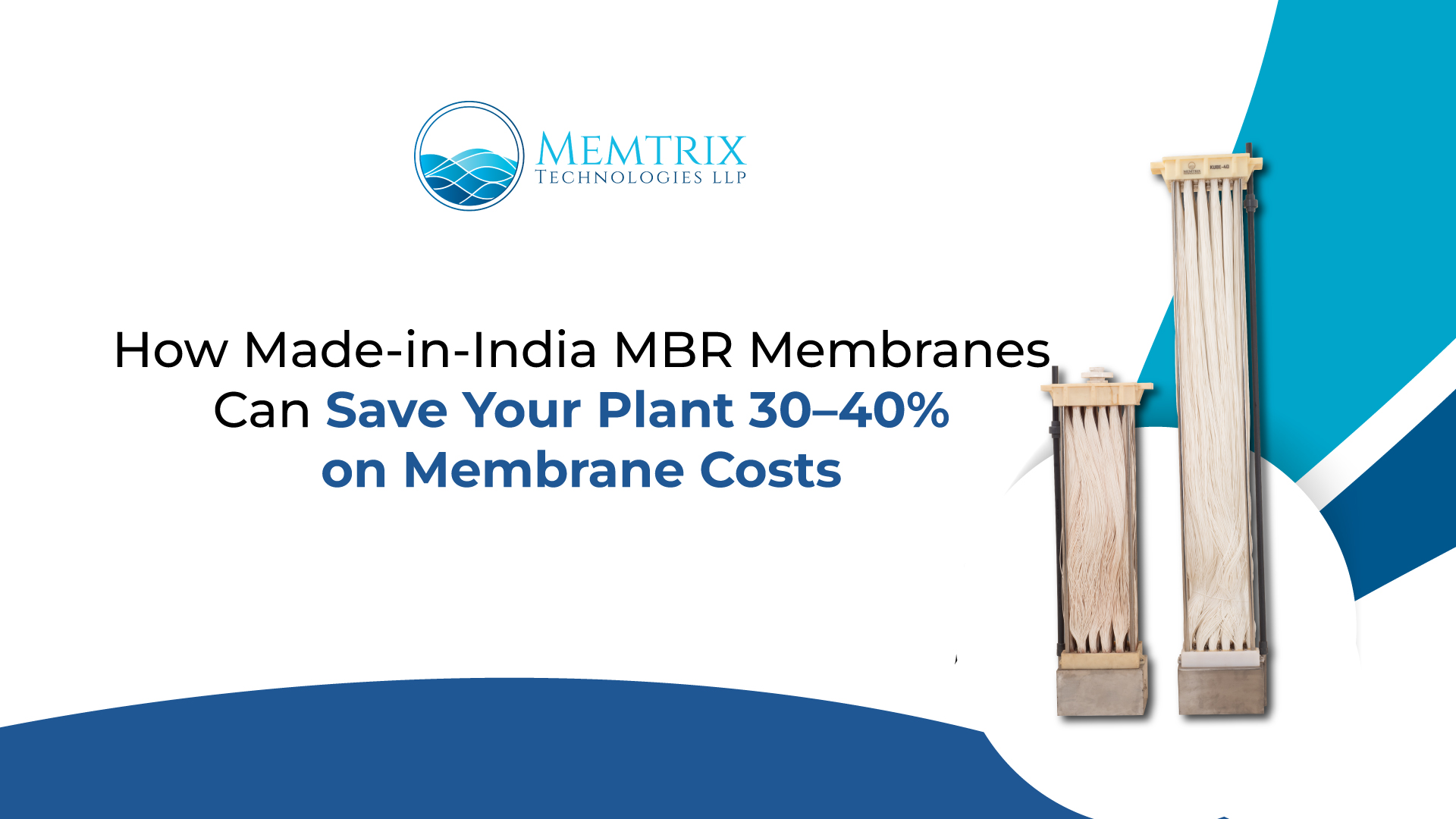
Made-in-India MBR membranes offer a significant change, providing 30-40% savings on total membrane costs without sacrificing performance. As Indian manufacturers increase production, these affordable wastewater membranes present a cost-effective solution that is reliable, scalable, and meets international standards. This article examines the figures, technology, and real-world success stories, highlighting why switching to domestic options could enhance your plant’s ROI.
The Rising Pressure on Wastewater Treatment Costs
Industrial plants in textiles, pharmaceuticals, food processing, and chemicals face growing challenges with wastewater. Strict regulations from the Central Pollution Control Board (CPCB) require treated effluent with BOD below 10 mg/L and TSS under 10 mg/L. MBR systems perform well here, combining biological treatment with ultrafiltration, despite the high costs of hollow fiber membranes that used to be prohibitive.
Common challenges include:
- High upfront costs: Imported membranes from Europe or the US can cost approx. ₹5,000-₹10,000 per square meter.
- Frequent replacements: Fouling and wear shorten their lifespan to 3-5 years, increasing annual operating expenses.
- Logistics issues: Import duties (up to 18% GST plus customs), shipping delays, and currency fluctuations add 20-30% more to total costs.
Procurement managers understand the challenge: a mid-sized ETP (500 KLD) could spend approx. ₹2-3 crore on membranes alone over five years. CFOs view this as a leak in profits, while operators face downtime from supply chain issues. This is where the local cost of MBR membranes in India proves advantageous; domestic production reduces these problems.
What Makes Indian MBR Membranes a Cost-Effective ETP Solution?
India’s membrane technology has rapidly progressed, driven by research from IITs, CSIR labs, and private innovators. Top Indian manufacturers like Memtrix Technologies, now produce hollow fiber membranes using materials like polyvinylidene fluoride (PVDF) or polyethersulfone (PES), meeting global specifications (0.01-0.1 micron pore size, 300-500 LMH flux).
Key benefits of affordable wastewater membranes from India include:
- Material Expertise: Domestic PVDF production lowers raw material costs by 25-30%, avoiding dependence on unstable global supply chains.
- Optimized Design: Improved anti-fouling coatings extend lifespan to 7-10 years, reducing the need for replacements.
- Economies of Scale: With facilities in Gujarat, Maharashtra, and Tamil Nadu, production has increased fivefold since 2020, resulting in hollow fiber membrane prices dropping.
- Customization: Designed for Indian effluents (high TDS, organics), ensuring rejection rates above 95% for COD and turbidity.
Compared to imports, Made-in-India MBR membranes offer comparable performance—flux rates of 20-40 LMH and TMP below 30 kPa—at a much lower cost. Certifications like ISO 9001, NSF/ANSI 61, and CPCB approvals ensure they can be easily integrated into ETP upgrades.
Crunching the Numbers: 30-40% Savings Breakdown
Let’s look at the costs for a 1 MLD (1,000 KLD) plant, a typical size for mid-sized manufacturers.
Baseline: Imported Membranes
- Hollow fiber membrane price: ₹7,000/m².
- Membrane area required: 4,000 m² (based on 250 LMH design flux).
- Initial cost: ₹2.8 crore.
- Lifespan: 5 years → Annualized cost: ₹56 lakh/year.
- Operating expenses (cleaning chemicals, energy): ₹20 lakh/year.
- Logistics/duties: ₹40 lakh upfront.
- 5-year total: ₹3.8 crore (₹76 lakh/year).
Switch to Made-in-India
- Hollow fiber membrane price: ₹3,500/m² (50% lower).
- Initial cost: ₹1.4 crore.
- Lifespan: 8 years → Annualized cost: ₹17.5 lakh/year.
- Operating expenses: ₹15 lakh/year (better fouling resistance).
- Logistics: Minimal (local delivery in 2-4 weeks).
- 5-year total: ₹1.66 crore (₹33 lakh/year).
Net savings: 56% over 5 years, which comes to 30-40% annually. With more stable currency pricing in rupees, this remains true even if the dollar spikes.
| Cost Component | Imported (₹ lakh/year) | Indian (₹ lakh/year) | Savings % |
| Capex Amortized | 56 | 17.5 | 69% |
| Opex | 20 | 15 | 25% |
| Logistics | 8 | 0.5 | 94% |
| Total | 84 | 33 | 61% |
CFOs, this isn’t just theory; it’s reality impacting your profits. Procurement teams can reallocate those savings to capital expenditures, while operators face fewer interruptions.
| Cost Component | Imported (₹ lakh/year) | Indian (₹ lakh/year) | Savings % |
| Capex Amortized | 56 | 17.5 | 69% |
| Opex | 20 | 15 | 25% |
| Logistics | 8 | 0.5 | 94% |
| Total | 84 | 33 | 61% |
**The figures are approximate numbers based on general industry benchmarks and typical price ranges for Indian MBR/hollow‑fiber membranes and their imported counterparts.
CFOs, this isn’t just theory; it’s reality impacting your profits. Procurement teams can reallocate those savings to capital expenditures, while operators face fewer interruptions.
Case Studies: Proven Wins from Indian Plants
Real-world examples support the benefits. Here are a few success stories from Indian MBR manufacturers:
Textile Company in Tirupur
A 2 MLD ETP replaced imported modules with local affordable wastewater membranes. Costs dropped by 35%, enabling 80% effluent reuse for cooling towers. Downtime decreased by 50%, achieving payback in 18 months.
Pharma Plant in Hyderabad
Facing ₹1.2 crore in import costs, they switched to PVDF hollow fibers from a Gujarat MBR manufacturer. Savings on hollow fiber membrane prices reached 42%. After installation, energy consumption fell by 15% due to improved packing density, generating ₹45 lakh in annual savings.
Food Processing in Gujarat
A dairy processing high-FOG wastewater selected a cost-effective ETP solution. Local membranes managed BOD spikes of 1,500 mg/L with ease, reducing chemical cleans by 30%. Total ROI showed a 28% IRR over five years.
These achievements are not exceptions; over 200 Indian installations since 2022 report 95% uptime and compliance.
Beyond Cost: Performance, Reliability, and Sustainability
While savings are eye-catching, Made-in-India MBR membranes offer additional benefits:
- Superior Durability: Tensile strength over 400 kg/cm² withstands chemical attacks typical in Indian effluents.
- Energy Efficiency: Reduced TMP means 20-25% less blower power, which is crucial for cost-focused CFOs.
- Environmental Benefits: Lower imports decrease the carbon footprint by 40% (shipping emissions), and recyclable materials align with sustainability goals.
- Service Support: Local manufacturers offer 24/7 monitoring, on-site training, and 5-year warranties that imported brands struggle to match.
For plant operators, modular designs simplify retrofitting into existing ETPs, minimizing shutdowns.
Implementation Roadmap for Procurement Managers
If you’re ready to proceed, here’s a 5-step rollout plan:
- Audit Current Setup: Determine your baseline cost of MBR membranes in India using flux and fouling data.
- Vet Suppliers: Narrow down Indian MBR manufacturers with pilot tests (most provide free 1-month trials).
- Pilot Test: Install 10-20% of the modules to evaluate hollow fiber membrane prices against performance.
- Scale Up: Finance using low-interest green loans (e.g., IREDA schemes).
- Monitor KPIs: Use IoT sensors to track savings in flux, TMP, and rejection rates.
Procurement tip: Negotiate volume discounts—top suppliers often reduce prices on affordable wastewater membranes for orders over 5,000 m².
Why Now? India’s Membrane Boom
Government incentives through PLI schemes and Atmanirbhar Bharat have significantly increased production capacity. By 2026, India plans to achieve 50% self-sufficiency in membranes, which will further stabilize costs. Delaying your decision means missing opportunities as imports rebound following supply chain issues.
Final Verdict: Transform Your ETP Today with Hollow Fiber MBR Membranes
Made-in-India MBR membranes are not just cheaper; they are smarter choices. Providing 30-40% savings on hollow fiber membrane prices, exceptional local support, and strong performance, they represent the best cost-effective ETP solution for savvy leaders. Procurement managers can secure better deals, CFOs can enhance margins, and operators can run more efficient plants.
Reach out to a certified Indian MBR manufacturer today—your profits will appreciate it.
Call us or whatsapp us at +91 6355038616
Follow . Share . Like
Additional Read
Reinforced PVDF MBR Membranes: High Durability Solutions for Advanced Wastewater Treatment
PVDF MBR Membranes: A Reliable Solution for Modern MBR Plants