Introduction: The need for advanced pharma effluent treatment is increasing.
India’s pharmaceutical industry is among the largest in the world. With rapid growth comes an equally rapid increase in complex wastewater. High COD (Chemical Oxygen Demand), APIs or Active Pharmaceutical Ingredients, antibiotics, solvents, and high TDS levels make pharmaceutical effluent far more challenging compared to municipal or typical industrial wastewater.
The challenge with conventional treatment methods is that they cannot always achieve these strict limits as per CPCB and SPCB norms, especially in terms of COD, BOD (Biochemical Oxygen Demand), color, toxicity, and residual antibiotics. And this is where pharma wastewater MBR technology, along with other membrane-based solutions, differs.
In this respect, MBRs, UF, NF, and RO are becoming indispensable tools for reliable compliance, low risk, and more sustainable water footprints across the Indian pharma industry.
Challenges in Pharmaceutical Wastewater Treatment
Pharmaceutical wastewater is far more complex than the typical industrial or municipal wastewater. It contains a diverse mix of organic chemicals, drug compounds, and dissolved solids that require advanced treatment approaches.
Key Challenges
- High and fluctuating COD and BOD loads
- Presence of APIs, antibiotics, hormones, and endocrine-disrupting compounds
- Toxic and non-biodegradable organics that resist conventional biological treatment
- Presence of strong color and odor
- Need for consistently low-turbidity effluent suitable for reuse or safe discharge
Limitations of Conventional Treatment Systems
(ASP, Extended Aeration, Conventional ETP)
- Poor settling and sludge bulking in clarifiers
- Inconsistent effluent quality during load variations
- Limited removal of micro-pollutants and trace APIs
- Large land requirement and complex civil infrastructure
Operational & Compliance Risks
Under increasing regulatory scrutiny and frequent environmental audits, these limitations can lead to:
- Compliance risks
- Potential penalties
- Operational disruptions
- Production constraints
What is a pharma wastewater MBR system?
A Membrane Bioreactor (MBR) for pharmaceutical wastewater is an advanced biological treatment system that combines a conventional aeration tank with membrane filtration. Instead of using gravity clarifiers to separate sludge from treated water, membranes physically retain biomass and solids, allowing only clean water (permeate) to pass through. This makes the process more compact, stable, and capable of producing consistently high-quality effluent suitable for reuse or safe discharge.
Main components of a typical pharma MBR system:
- Equalization tank with pH adjustment
- Biological reactor (aerobic or anoxic–aerobic as required)
- Submerged or external UF membranes (hollow fiber or flat sheet)
- Permeate pumps, air blowers, and membrane cleaning system
- Online monitoring and automation for stable operation
Key outcome:
A compact, high-performance treatment system that delivers low-turbidity effluent with very low BOD, suspended solids, and pathogens.
Why MBR is suitable for pharmaceutical wastewater
For the Indian pharma units, the pharma wastewater MBR system presents certain clear advantages over the conventional processes:
- Superior effluent quality:
The UF membranes act as a physical barrier, and the suspended solids are removed almost completely, a large fraction of bacteria and pathogens is removed, producing crystal-clear water ready for polishing (NF/RO, AOP, etc.).
- Higher MLSS and smaller footprint:
MBRs operate at much higher MLSS levels than ASP, thereby offering more biomass in less space and a land requirement reduced by up to 40–60%.
- Stable performance under load variation:
Because of the membrane barrier, the effluent quality will remain constant, even if the influent conditions may change, which is essential during batch production cycles for compliance purposes.
- Reduced sludge generation:
Greater SRT means a lower volume of excess sludge, hence decreasing the cost of handling and disposal.
- Easy integration with advanced polishing steps:
High-quality MBR permeate is a very promising feed for nanofiltration, reverse osmosis, and AOPs designed for API and micro-pollutant removal.
For plants facing consistent compliance issues, MBR becomes the backbone of a robust treatment approach.
Solutions Beyond MBR: UF, NF, and RO
Although the pharma wastewater MBR is the centerpiece of biological treatment, a complete membrane-based solution generally encompasses various steps, depending on specific effluent characteristics.
Ultrafiltration (UF)
- Often incorporated in the MBR itself as the primary separation process
- Can also be used as a polishing step for tertiary treatment
- Removes suspended solids, colloids and most bacteria
- Produces low-turbidity water suitable for RO feed
Nanofiltration (NF)
- Targets multivalent ions and larger organic molecules
- Useful for partial softening and reduction of color, COD, and specific APIs
- Consumes less energy than RO, while offering good removal of many pharmaceutical compounds
Reverse Osmosis, RO
- Provides the highest level of dissolved solids and micro-pollutant removal
- Essential in the zero liquid discharge schemes
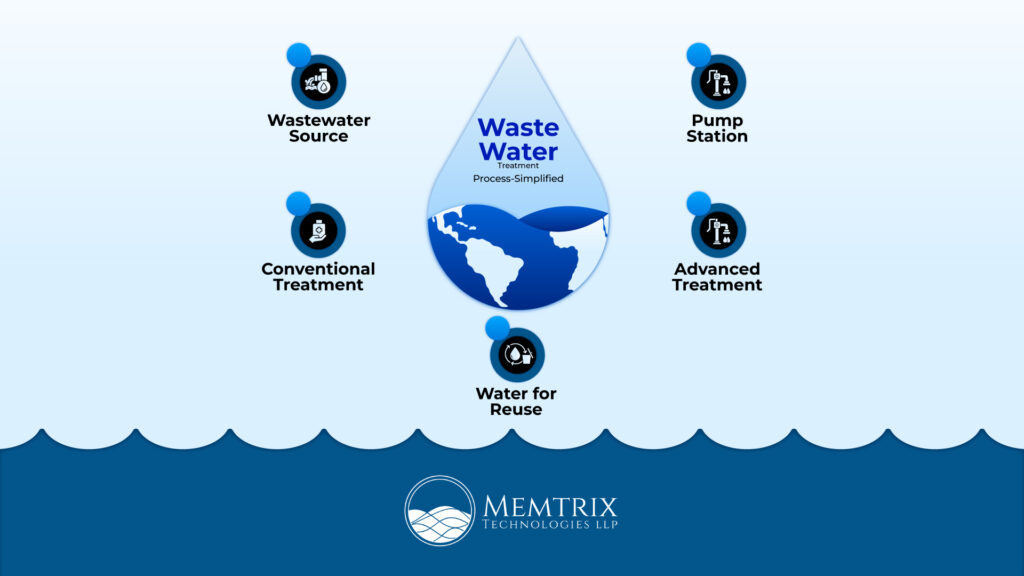
Typical Pharma Wastewater MBR Plant Process Flow
The following is a typical, effective configuration for the treatment of pharmaceutical effluent in India:
1. Pre-treatment
- Screening, oil and grease removal
- Equalization basin with pH control and homogenization
- Optional physico-chemical treatment for highly toxic streams
- Biological Treatment through Pharma Wastewater MBR
- Aeration tank with optimized nutrient dosing and DO control
- Submerged UF modules for solid–liquid separation
- Online monitoring of MLSS, TMP, DO, and permeate quality
- Polishing and Tertiary Treatment
- Activated carbon filters or AOP for color, odor and persistent organics
- NF / RO for dissolved salts and micro-pollutant removal
- Disinfection: UV/ chlorination, where required.
- Reuse / Disposal
- High-quality permeate reused for utilities, gardening or cooling
- RO reject sent to MEE/ATFD or ZLD system if mandated
This integrated approach ensures pharma plants achieve both regulatory compliance and water sustainability.
Key benefits of membrane-based pharma effluent treatment
The pharma-specific membrane solution provides several tangible benefits:
- Consistent compliance:
High and repeatable quality of effluent even when production schedules and formulations change.
- Compact footprint:
It is ideal for brownfield sites where space is limited, especially in pharma industrial clusters.
- Scalability and modularity:
Easy to expand capacity with the addition of membrane modules or trains as production increases.
- Lower overall lifecycle cost:
Adding up the penalties that are avoided, reduction of water purchase, and reduced sludge handling, the total cost of ownership usually comes out in favor of MBR+RO over obsolete ETPs.
- Brand and ESG impact:
Demonstrating advanced, sustainable wastewater management enables ESG reporting, investor confidence, and global customer audits.
Design & Operational Considerations for Pharma Wastewater MBR
For a pharma wastewater MBR system to perform reliably over the long term, a few practical design and operation choices make all the difference.
Understand the wastewater first
A detailed analysis of COD, BOD, TDS, toxicity, APIs, and load variations helps select the right biological process and membrane setup.
Segregate high-strength streams
Highly concentrated, toxic, or solvent-rich streams should be treated separately (e.g., evaporation or incineration) instead of overloading the main ETP.
Choose the right membrane system
Selecting between hollow fiber or flat sheet, submerged or external configurations — along with proper flux design — ensures stable operation and lower fouling risk.
Plan for fouling control
Routine backwashing, air scouring, and periodic chemical cleaning keep transmembrane pressure under control and extend membrane life.
Use smart automation & monitoring
Online sensors with PLC/SCADA and remote monitoring enable proactive operation and faster response to process upsets.
Bottom line:
Partnering with an experienced membrane technology provider like Memtrix technologies is often the key to consistent performance, uptime, and compliance in real-world pharma operations.
Future Trends: Towards Circular Water in Pharma
With increasing water stress and regulatory pressure, the future direction of pharmaceutical wastewater treatment in India is clearly towards:
- Higher on-site water reuse with MBR + RO + AOP
- Digitalization and real-time monitoring for better control and optimization
- Integration with ZLD systems in sensitive catchments or cluster-based mandates
- Emphasis on micro-pollutant and API removal to address long-term environmental and health effects
Consequently, membrane technologies will be at the heart of this transition, where the pharma wastewater MBR systems will form the core biological treatment platform.
Conclusion: Choosing the Right Membrane Partner for Pharma Wastewater
Advanced membrane solutions are no longer an option but a strategic necessity for the Indian pharma companies. A well-designed pharma wastewater MBR system like Memtrix Technologies provide which is integrated with UF, NF, RO, and appropriate polishing technologies can deliver:
- Reliable compliance with CPCB/SPCB norms
- Reduced operational risk and improved audit readiness
- Significant savings from water reuse and efficiency operation
- Tangible ESG and sustainability benefits
Upgrading your ETP to an MBR-based membrane solution is one of the most effective ways to secure your license to operate and support sustainable growth in India’s competitive pharmaceutical landscape.
Call us or whatsapp us at +91 6355038616
Follow . Share . Like
Additional Read
Ultrafiltration Membrane Module in Wastewater Recycling Explained
What Is a Hollow Fiber Membrane? Working Principle & Key Advantages
MBR vs Conventional Treatment: Why Membrane Systems Are the Future