Introduction: The Future of Water Reuse Lies in Ultrafiltration
Water scarcity is no longer a looming threat — it’s a present-day reality for industries worldwide. As the demand for sustainable water management grows, ultrafiltration membrane modules have emerged as a key enabler of wastewater recycling and reuse. From textile dye effluents to food processing plants and municipal sewage, ultrafiltration (UF) plays a crucial role in transforming contaminated water into a reusable resource.
This article breaks down everything you need to know about ultrafiltration in wastewater recycling — how it works, what makes it effective, where it’s used, and why the ultrafiltration membrane module is fast becoming the preferred choice for industrial water treatment systems.
What Is Ultrafiltration (UF)?
Ultrafiltration is a pressure-driven membrane filtration process that separates suspended solids, oils, bacteria, and macromolecules from water. It acts as a physical barrier that allows water and small dissolved substances to pass through while rejecting particles and microorganisms larger than the membrane pores (typically 0.01 to 0.1 microns).
The heart of every UF system is the ultrafiltration membrane module — a compact assembly containing hundreds or thousands of hollow fibers or flat sheets that perform the filtration task. These modules are designed to provide high surface area, durability, and easy cleaning for long-term operation.
How Ultrafiltration Membrane Modules Work
Ultrafiltration operates on a simple principle: applying pressure to drive water through a semipermeable membrane. The feedwater passes along the surface of the membrane fibers, and clean water (called permeate) passes through the membrane pores. The retained contaminants form a concentrate stream, also known as the retentate.
Key components in an ultrafiltration system:
- Feed pump: Pressurizes the incoming wastewater.
- UF membrane module: Houses the membranes that perform separation.
- Permeate outlet: Collects purified water ready for reuse or further treatment.
- Concentrate outlet: Discharges the retained particles or directs them for sludge management.
Two typical UF flow configurations:
- Dead-end filtration: All feedwater passes through the membrane; solids accumulate on the surface.
- Cross-flow filtration: Part of the feedwater flows parallel to the membrane to minimize fouling and flush out impurities.
The Science Behind UF: Filtration by Molecular Size
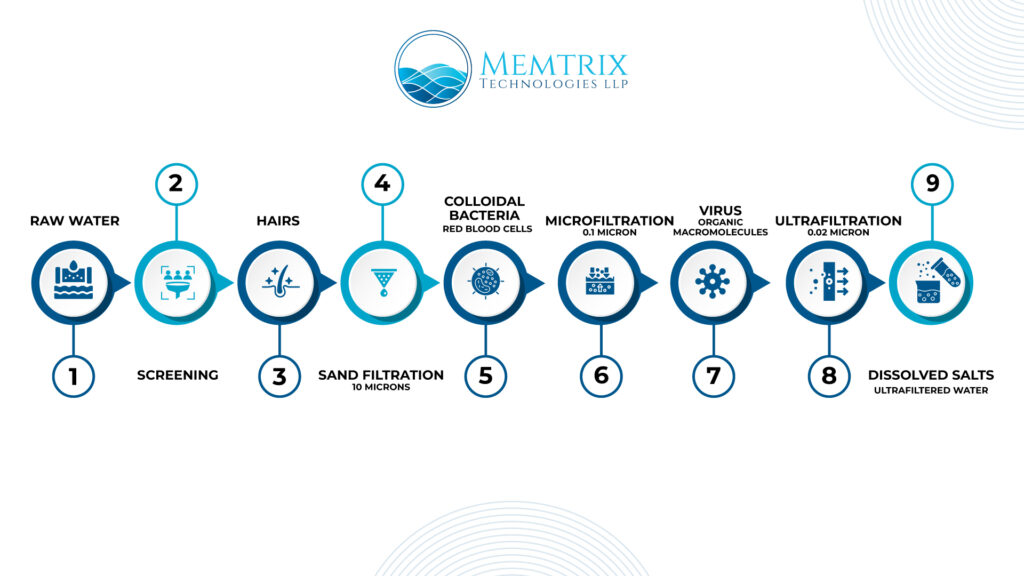
To understand the power of UF membranes, it helps to look at how it compares with other filtration methods. The ultrafiltration membrane module sits between microfiltration and nanofiltration on the filtration spectrum.
| Filtration Type | Pore Size (µm) | Retains | Application Example |
| Microfiltration | 0.1 – 1.0 | Suspended solids, large bacteria | Pre-filtration before UF or RO |
| Ultrafiltration (UF) | 0.01 – 0.1 | Bacteria, colloids, proteins, organics | Industrial wastewater treatment |
| Nanofiltration | 0.001 – 0.01 | Divalent ions, small organics | Softening, colour removal |
| Reverse Osmosis (RO) | <0.001 | Dissolved salts, all ions | Desalination, ultrapure water |
With a typical pore size of 0.03 microns, UF membranes effectively remove 90–99% of suspended solids and most microorganisms — making them ideal as a pretreatment step before RO or as a standalone polishing process in wastewater reuse systems.
Materials and Design of Ultrafiltration Membrane Modules
Modern ultrafiltration membranes are engineered for both robustness and selectivity. Common materials used include:
- Polyethersulfone (PES): Popular for its high permeability and chemical resistance.
- Polyvinylidene fluoride (PVDF): Known for strong mechanical strength and fouling resistance.
- Polysulfone (PS): Excellent for high-flow industrial systems with strong caustic tolerance.
- Ceramic membranes: Used in high-temperature or highly contaminated wastewater for longer lifespan.
Membrane module configurations:
- Hollow fiber modules: Thousands of thin fibers enable high surface area in a compact design.
- Spiral wound modules: Flat-sheet membranes rolled around a central tube for higher flux applications.
- Tubular modules: Preferred for viscous wastewater streams like dairy, brewery, or oil effluents.
Each ultrafiltration membrane module is optimized for flow rate, recovery, and cleanability depending on the industry and application.
Advantages of Ultrafiltration in Wastewater Recycling
Ultrafiltration is gaining popularity because it combines efficiency, reliability, and sustainability. Here’s why industries are adopting UF-based recycling systems:
- High-quality permeate: Produces crystal-clear water free from bacteria and turbidity (<0.1 NTU).
- Low chemical usage: Operates primarily on physical separation, minimizing chemical additives.
- Compact and modular design: UF membrane modules can be easily scaled up or replaced.
- Reduced sludge production: Compared to conventional clarification systems.
- Stable operation: Resistant to feedwater fluctuations common in industrial waste streams.
- Pretreatment for RO systems: Protects downstream reverse osmosis membranes from fouling and scaling.
- Energy-efficient: Operates under low pressure (1–5 bar) compared to RO systems.
Collectively, these advantages translate into lower operating costs, smaller footprints, and improved water recovery rates.
Common Applications of UF Membrane Technology
Ultrafiltration is no longer limited to municipal facilities — it finds application across diverse industries.
- Textile and Dyeing Industry:
Removes dyes, suspended solids, and sizing agents from process water. UF-treated water can be reused for dye bath preparation or rinsing operations. - Food and Beverage Processing:
Concentrates proteins, purifies process water, and ensures reuse without contamination. UF systems are used in cheese whey concentration, sugar syrup clarification, and beverage filtration. - Pharmaceutical Manufacturing:
Provides microorganism-free water for cooling, cleaning, and product formulation processes. - Oil and Gas Sector:
Treats produced water, oily wastewater, and reinjection water by removing hydrocarbons and suspended solids. - Automotive and Metal Finishing Plants:
UF modules efficiently remove oil emulsions and paint residues from rinse water, allowing cost-effective recycling. - Municipal and Domestic Wastewater:
Enhances tertiary treatment by polishing secondary effluent to achieve high-quality reclaimed water for non-potable reuse.
Cleaning and Maintenance of UF Membrane Modules
Fouling — the accumulation of unwanted materials on the membrane surface — is inevitable in UF systems. Regular cleaning and maintenance ensure long-term stability and performance.
Cleaning methods include:
- Backwashing: Reversing flow periodically to remove surface deposits.
- Air scouring: Releasing air bubbles to physically disrupt fouling layers.
- Chemical Cleaning-in-Place (CIP): Using mild alkalis, acids, or disinfectants to dissolve organic and inorganic foulants.
- Maintenance cycles: Typically every 30–60 minutes of operation, depending on feed quality.
Manufacturers design ultrafiltration membrane modules for easy cleaning access and automated backwash cycles, reducing downtime and maintenance costs.
Integration with Other Treatment Processes
UF systems often work as part of a multi-stage treatment chain. For maximum water recovery and purity, UF is commonly paired with:
- Coagulation–flocculation: Removes larger particulates before UF to extend membrane life.
- Activated carbon filters: Adsorb organic compounds not removed by UF.
- Reverse osmosis (RO): Uses UF-treated water as feed for high-quality desalination or demineralization.
- UV or ozone systems: Provide final disinfection where reuse requires zero bacterial presence.
This integrated approach ensures both compliance with discharge norms and feasibility for industrial reuse.
Case Study: UF System in Industrial Water Reuse
A large-scale textile dyeing plant in South India implemented a UF–RO hybrid system to recycle up to 80% of its wastewater. The ultrafiltration membrane modules act as a pretreatment to remove color, suspended particles, and oil. With UF ensuring high-quality feedwater, the downstream RO unit could operate reliably with reduced chemical cleaning. The result: operational costs dropped by nearly 25%, and the plant met state pollution control reuse standards.
Key Performance Metrics for UF Systems
When designing or evaluating a UF installation, engineers focus on critical performance indicators:
| Parameter | Typical Range |
| Operating Pressure | 1–5 bar |
| Permeate Flux | 40–120 L/m²·h |
| Recovery Rate | 85–95% |
| Turbidity of Permeate | <0.1 NTU |
| Bacteria and Virus Removal | >99.9% |
| Chemical Oxygen Demand (COD) Reduction | 50–85% |
These metrics prove why ultrafiltration membrane modules provide reliable, consistent, and high-quality output for critical industrial reuse operations.
Emerging Trends in Ultrafiltration Technology
Innovation in UF technology continues to evolve around efficiency, automation, and sustainability:
- Energy-optimized operation: Development of low-transmembrane-pressure membranes.
- Smart monitoring systems: Real-time fouling detection using IoT sensors.
- Hybrid ceramic-polymer membranes: Combining durability with cost-effectiveness.
- Zero liquid discharge (ZLD) integration: UF serving as a critical pre-concentration stage.
- Green cleaning agents: Bio-based chemicals replacing traditional acids and caustics.
These advancements reinforce the role of ultrafiltration membrane modules as a cornerstone of future-ready water management systems.
Environmental and Regulatory Impact
With increasing environmental regulations and water reuse mandates, industries must adopt sustainable solutions for wastewater treatment. Governments across Asia, Europe, and the Middle East now encourage recycling through policy incentives and discharge limitations. Implementing UF membrane-based systems helps companies align with ISO 14001 environmental standards and reduce freshwater dependency.
Besides regulatory compliance, UF adoption enhances corporate sustainability goals by cutting water procurement costs, conserving resources, and supporting circular economy models.
Conclusion: Why UF Membrane Modules Are Key to Circular Water Management
Ultrafiltration is no longer an optional upgrade—it’s a necessity for industries aiming for zero waste and sustainability. The ultrafiltration membrane module is the heart of this transformation, providing an efficient, modular, and cost-effective solution for wastewater recycling. Whether used as a standalone treatment or in combination with RO and biological systems, UF ensures a consistent supply of high-quality water ready for reuse.
As industries continue to face rising water costs and stricter discharge norms, investing in Ultrafiltration Membrane Module technology made by Memtrix technologies LLP is not just good for compliance—it’s good for business continuity and environmental stewardship.
Call us or whatsapp us at +91 6355038616
Follow . Share . Like
Additional Read
What Is a Hollow Fiber Membrane? Working Principle & Key Advantages
MBR vs Conventional Treatment: Why Membrane Systems Are the Future